
Although Sapa is often the first place that comes to mind when discussing Northern Vietnam, there are other areas in the country that offer spectacular landscapes far from the most frequented tourist routes. Ha Giang is one of these wild, remote, and somewhat undiscovered regions of Vietnam. This is one of the areas we recommend when planning your trip to Vietnam.
What Ha Giang is like
Ha Giang is a province of Vietnam located in the far north of the country. In fact, Vietnam’s northernmost point is in this province, which means Ha Giang shares a 270 km border with China’s Yunnan province. The provincial capital is also called Hà Giang and is connected by expressway to Hanoi, 320 km to the south.
What to do and see in Ha Giang
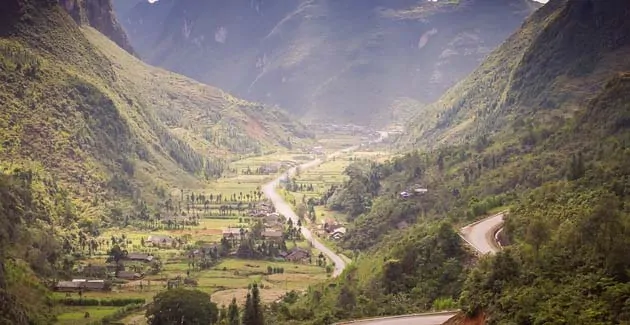
The whole province has a predominantly rural economy, transport links are not very developed, and it is not a destination that offers the typical attractions and comforts sought by Western tourists. So, if your intention is to visit an area of Vietnam that has not yet been overtaken by mass tourism and to venture into lesser-known territory, meet Southeast Asian ethnic groups found only in these areas, and enjoy a more immersive experience, you should make a stop in Ha Giang during your route through Vietnam.
Scenic and photographic route
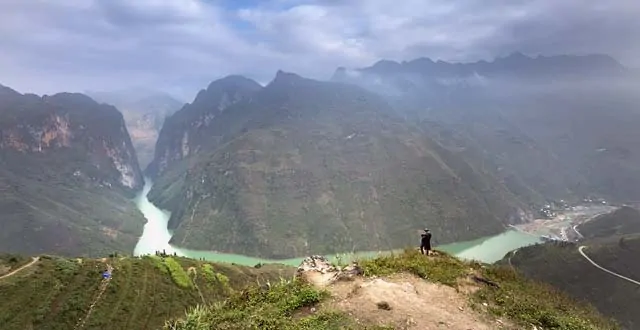
If you search online for the region, you will likely come across the term Ha Giang Loop, which could be translated as “the loop around Ha Giang.” Most visitors who come to this remote area of Vietnam do so to travel the famous 4C road that crosses the entire region, with the highlight being the Ma Pi Leng Pass, a high mountain pass with breathtaking views. The full circuit through the province’s different towns along the 4C road is what is known as the Ha Giang Loop.
Away from the traditional tourist routes
Ha Giang is one of the poorest and most rural areas of Vietnam. There is not much transport infrastructure, the terrain is mountainous, with frequent fog and low temperatures in winter, and getting there is more complex than reaching other, better-known parts of the country. However, this isolation has given Ha Giang a distinct identity, with cultural, ethnic, and scenic richness that remains virtually intact.
How to get to Ha Giang
Ha Giang’s only connections with the rest of the country are by bus. You can get there from Hanoi on a night bus or from Sapa on a regular bus in around 6 hours.
Attractions in Ha Giang
We recommend that if you travel to Ha Giang, you get around in two ways:
- If you are confident on two wheels, we recommend renting a motorbike to explore the area.
- If you prefer comfort and high-quality information, hire a personal guide who will help you tour the province in complete comfort.
In fact, most activities in this area of Vietnam are based on guided tours that last several days, whether on foot on a trek, in an off-road vehicle or 4×4, or on a dirt bike with a guide who takes you to the most hidden corners of Ha Giang’s forests. It is also quite common to stay with a local family as a “homestay,” meaning sharing their home and meals as if you were another member of the family. In any case, with or without a guide, Ha Giang’s main highlights are its spectacular landscapes and its ethnic groups halfway between Vietnam and China, especially the H’mong, who have dominated much of this territory since the 18th century. In addition to the H’mong, the Tay, Dao, Nung, and Lô Lô ethnic groups are also noteworthy. The main places to visit on your trip to Ha Giang are as follows.
Ma Pi Leng Pass

If you travel the route known as the Ha Giang Loop by motorbike, the Ma Pi Leng Pass is one of the must-stop hotspots. The views of the winding road (which you will necessarily have taken to get up there) leave no one indifferent. The Ma Pi Leng Pass is about 20 kilometers long and sits at an altitude of around 1,500 m above sea level.
Dong Van Karst Plateau Geopark
The Dong Van Karst Geopark is an elevated plateau of major geological importance, as it is one of the few places in the world that shows how the Earth’s crust has formed over time. The protected area covered by the geopark spans a very large part of Ha Giang, so during your journey through the region you will in fact already be within it. Geologically set on one of the foothills of the Himalayas, the Dong Van Karst Plateau offers mountain formations, curious rock formations, and beautiful geological structures, and it is also an important paleontological site due to the large number of fossils found in the area. The Dong Van Geopark has been part of the UNESCO Global Geoparks Network since 2010.
Lung Cu Tower
The Lung Cu Tower, or Lung Cu Flag Point, is a 30-meter-tall tower-shaped monument at the top of Lung Cu Peak, at 1,400 m above sea level. The monument is crowned with a Vietnamese flag and was built to mark the northernmost point of the country (although in reality the border with China lies 3 km from there). From the top of the tower you will have breathtaking views of the area.
Thon Tha Village
This village is one of the best options for a homestay, that is, living for a few days with a Tay ethnic family in this area of Vietnam. The homestay concept has been promoted by the Ha Giang government itself through a cooperative created for this purpose, to promote tourism in the area on the one hand, and to improve the living conditions of the ethnic groups living there on the other. The idea of a homestay is for visitors to integrate into local life, preserving social and cultural values while also helping locals develop tourism-related activities: trekking, guiding, etc. In Thon Ta Village you will find friendly people and can live for a few days like a local, getting to know their culture, customs, and food.
Lung Khuy Cave
Near the village of Tam Son, about 7 km away, you will find Lung Khuy Cave, a must-stop if you are in the area. In the cave, with a route of around 300 meters, you can observe stalactites and very interesting limestone formations in a site that was recently opened to the public (it was made accessible for visits in 2015). The journey to Lung Khuy will allow you to observe and enjoy the surrounding landscape.
Hoang Su Phi rice terraces
There are photos of rice terraces that will take your breath away, and we can assure you that some of them were taken in Hoang Su Phi, a rural area spanning several square kilometers and home to some 50,000 farmers. These rice terraces are, in fact, the foundation that sustains the local population. To explore the Hoang Su Phi area, we recommend hiring a guide who can show you the most impressive and hidden corners of this region, which has remained apart from the tourism development Vietnam has experienced over recent decades. If you want to travel back in time during your visit to Vietnam, the Hoang Su Phi rice terraces are a great way to do so.
Ha Giang Ethnic Museum
If you want to begin or end your visit to Ha Giang with something a bit more cultural (the logical choice is to do it upon arrival in Ha Giang), we recommend visiting the Ha Giang Provincial Ethnic Museum. This small museum showcases the area’s ethnic richness through clothing and descriptions of the traditions of the different communities that live there. However, there is not much historical information. If you are travelling around Ha Giang with a guide, they can provide the same information you would find in the museum during your route.


