
You have surely often heard of Angkor Wat, even if you have never visited Cambodia or any other Southeast Asian country. And even if you have never even heard of this place, you have certainly seen photographs online, in travel magazines, or in documentaries; even if the name Angkor Wat means nothing to you, you will surely recognize some of the images we include in this post from having seen them on another occasion.
The builders of Angkor Wat: the Khmer Empire
The Khmer Empire (Khmer) was the predecessor state of modern Cambodia and the builder of Angkor Wat. It was a Hindu-Buddhist empire that for centuries controlled much of Southeast Asia. The empire, which emerged from the fusion of the ancient kingdoms of Funan and Chenla, at certain periods ruled and/or controlled most of mainland Southeast Asia and parts of southern China, extending from the northern tip of the Indochina Peninsula to the modern Chinese province of Yunnan, and from Vietnam in the east to the Andaman Sea coast to the west (present-day Myanmar). From the 14th century onwards, the Khmer Empire began to suffer an unstoppable decline due to the gradual conversion of its population from Hinduism to Buddhism, internal revolts, invasions, epidemics (the Black Death), and the ecological and environmental collapse of its surroundings.

Angkor Wat is—here is the key fact—the largest religious monument complex in the world. Originally built as a Hindu temple dedicated to the god Vishnu for the Khmer Empire (Khmer in its original name), it gradually became a Buddhist temple at the end of the 12th century, as the empire’s population changed its form of worship. Angkor Wat combines two fundamental plans of Khmer temple architecture: the temple-mountain and the later gallery-temple design. After the city was abandoned, most of it was hidden beneath the jungle, which slowly but inexorably took over the entire area. Only one of the temples was permanently inhabited by Buddhist monks. Although Angkor Wat had always been known, its fame reached the West in the 19th century, when the French naturalist Henri Mouhot visited the area on an expedition.
Big, very big
Angkor Wat is vast. We are talking about a total area of 82 hectares, which is the same as 114 football fields. Therefore, we recommend that if you visit, you do not do it in just one day, as you will only have time to see a very small part of its total extent. The architectural complex is made up of more than 1,000 temples, so plan your visit well to focus on the most interesting ones.
How to get to Angkor Wat

The closest city to Angkor Wat is Siem Reap. Getting to Siem Reap is easy with a domestic flight from any airport in a neighbouring country, or by bus from Bangkok, Chiang Mai, and most major cities in Southeast Asia. In addition, Siem Reap is quite a touristy city (partly thanks to Angkor Wat itself), so you can also take the opportunity to visit the city and its surroundings while you are there. To visit Angkor Wat, you should also base your accommodation in Siem Reap itself, as the monument complex is just 7 kilometres from the city. The best option to get to Angkor Wat, in terms of price and comfort, is a tuk-tuk: it will pick you up at your hotel, and you can agree the price in advance to avoid surprises with the fare. If you have rented a car or a motorbike during your trip, the journey will take just 10 to 15 minutes from Siem Reap, depending on exactly where you are staying.
How to visit Angkor Wat

If you want to visit Angkor Wat effectively, there is only one solution: plan ahead. Planning is key to avoiding wasted time and money, as Angkor Wat has several particularities:
- It is extremely large: the temples are separated from one another by kilometres, surrounded by moats that force you to take detours and spaced out by dense jungle, which means each trip within the site requires a considerable investment of time.
- Admission is not exactly cheap: at 2019 prices, a one-day ticket costs 37 dollars. There are ticket packs for three or more days, reducing the daily price as you book more days at once.
- There are more than 1,000 temples to visit: therefore, it is an excellent idea to plan ahead and decide which ones you want to see and in what order, to optimise every journey and hour of your visit as much as possible.
- Learn before you arrive: you are looking at the largest religious complex on Earth, so to appreciate and value what is in front of you, it is a good idea to read up and inform yourself in advance so you understand what you are seeing from the first moment you have it in front of you.
- If you want to be on the safe side: hire a guide or join a group guided tour. The guide will help you understand and appreciate each of the buildings you visit.
Angkor Wat opening hours
The complex is open every day from 5:00 to 18:00. As many people stay in the complex to watch sunset, staff sometimes extend closing time until the sun has disappeared below the horizon, especially during the months when the days are longer.
Sunrise at Angkor Wat
Opening time also allows you to watch sunrise from within the site, with the dark silhouette of the temples outlined against the orange and golden morning sky. Early starts are also recommended if you want to see the area’s wildlife wake up: listening to the morning birdsong filling the whole surroundings with melodies, or watching the monkeys go to drink water from the river as soon as they wake up. Sunrise at Angkor Wat requires a very early start (plan to leave your hotel at around 4:30 AM), but it will allow you to enjoy stunning views that, if you are a photography lover, you should not miss. Any simple smartphone app or a quick Google search will let you know the exact time of sunrise at Angkor Wat on the specific day you are there, so you can plan your journey.
Visitor routes
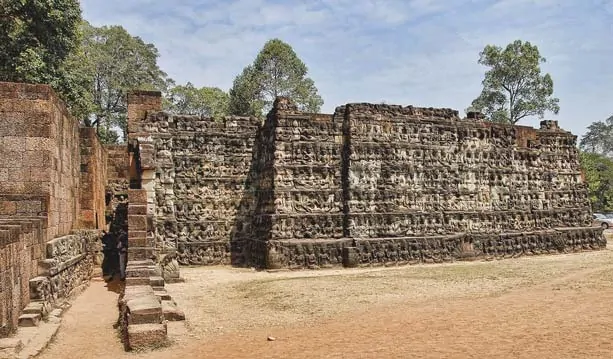
To make things easier for visitors, there are two pre-designed routes, one longer and one shorter, which allow you to see the main monument groups within the site.
Angkor Wat short circuit
It is 18 kilometres long, visiting the site’s main temples, such as Angkor Wat, Elephant Terrace, Ta Prohm and Bayon. You will also visit many other secondary temples.
Angkor Wat long circuit
It is roughly a 28-kilometre route and allows you to visit temples that are also relevant but are located away from the area’s central hub, such as Neak Pean or Preah Khan.
Getting around inside Angkor Wat
There are several ways to get around the vast area covered by the Angkor Wat monument complex. As you can imagine from what you have read in the previous section, walking 18 kilometres (short circuit) or 28 kilometres (long circuit) is not feasible. For that reason, all Angkor Wat visitors get around on wheels, motorised or not. You have the following options for getting around within the site.
Private tour
It is the best option both for getting around and for the quantity and quality of information you can obtain about the complex. Private tours normally include transport, bottles of water for the group, and the guide who will explain the details and history of Angkor Wat. Get in touch with us so we can organise a tailor-made tour for you.
Tuk-tuk
If you are a large group, the Tuk-Tuk is the best way to get around the complex, as each of you will end up paying a very competitive price for the day’s travel. Tuk-Tuks usually do not act as guides and simply serve as “taxis” for you.
Taxi
It is by far the most expensive option. Having a car and driver with air conditioning comes at a price, in Angkor Wat and almost anywhere in the world.
Bicycle
If you are brave, sporty, and fit, cycling is an option worth considering. In addition, renting a bicycle is by far the most economical option you will find. In an increasingly environmentally conscious world, bicycles are an increasingly common choice for many visitors. That said, if you are going to get around by bike, bring enough water and food because you will sweat and burn a good number of calories that day.
Motorbike
For some years now, it has been possible to access Angkor Wat with your own motorbike. It is the quickest and most fun option if you are comfortable on two wheels.
The main temples in Angkor Wat
There are around 1,000 temples (yes, you read that right, 1,000) within the site. However, the main ones are the following.
Angkor Wat

The king of the complex and the most photographed silhouette. It is the largest religious building in the world. Today, there are still Buddhist monks in this temple, and it remains in good condition as it was not swallowed up by the jungle like many other temples in Angkor.
Angkor Thom
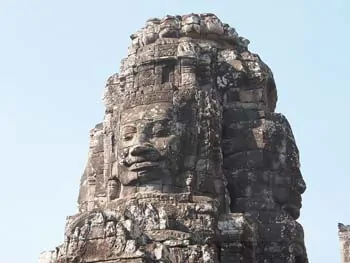
Angkor Thom is not a temple in itself, but rather a walled city with several temples inside. Within Angkor Thom are several of the site’s most well-known temples, which we will look at next.
Bayon

It is the most important place of worship within the city of Angkor Thom. The perfectly carved stone faces are the most characteristic feature of this temple. You will find more than 200 of them.
Ta Prohm

Ta Prohm is the temple that best shows the consequences of Angkor Wat being abandoned by its inhabitants and how the jungle reclaimed the territory humans had taken from it. Tree roots have engulfed Ta Prohm, creating a fusion of nature and human structures of striking beauty and uniqueness. In fact, Ta Prohm Temple was one of the filming locations for the first Tomb Raider movie.
Baphuon
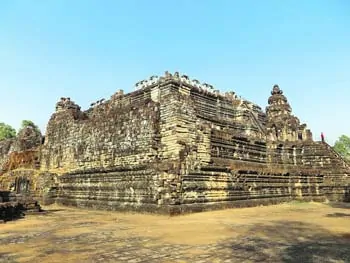
Baphuon is a pyramid-shaped temple that you can climb to the top to enjoy stunning views of the surroundings from 25 metres high.
Elephant Terrace
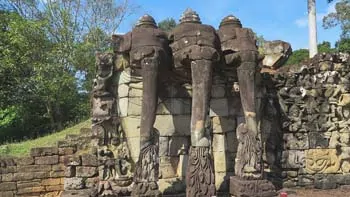
Still within the walled city of Angkor Thom, you will find the Elephant Terrace, an elevated terrace or platform from which Emperor Jayavarman could watch his army return after a battle in which it had emerged victorious. It owes its name to the carved elephants found on columns and bas-reliefs.
Preah Khan
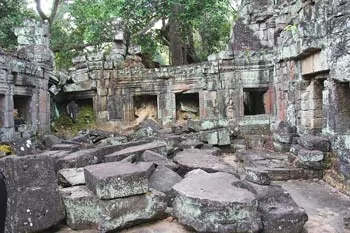
It is one of the temples for which the least effort has been made to restore its original appearance; therefore, the trees growing inside have been left almost intact as they were on the day it was found. It is located northwest of the aforementioned citadel of Angkor Thom, and Preah Khan was an important organisational centre, with many employees and service staff living in the surrounding area.
Pre Rup

Pre Rup is important because it is a Hindu temple within the Angkor Wat complex, whose temples gradually transformed to Buddhism. The temple has a central pyramid and several lateral and secondary pyramids, and you can see many details, engravings, and structures explicitly dedicated to Hinduism.
Other tips for an optimal visit
- Wear comfortable clothing and trainers.
- Bring water and, if you want to save some money, bring your own food. There are restaurants inside the complex, but they are somewhat more expensive than those in the surrounding area.
- The ticket is personal and non-transferable (they actually take your photo when you buy it), so avoid at all costs resale offers and similar outside the usual channels: they will be scams.
- Try to cover your shoulders (do not wear tank tops) and do not wear very short trousers; there is a dress code for entering the temples and some guards are completely inflexible about non-compliance.
- Once again, we recommend a private tour for a high-quality visit and first-hand information from a local guide. You can find more information about the tours we run daily at Onemoredestination.


