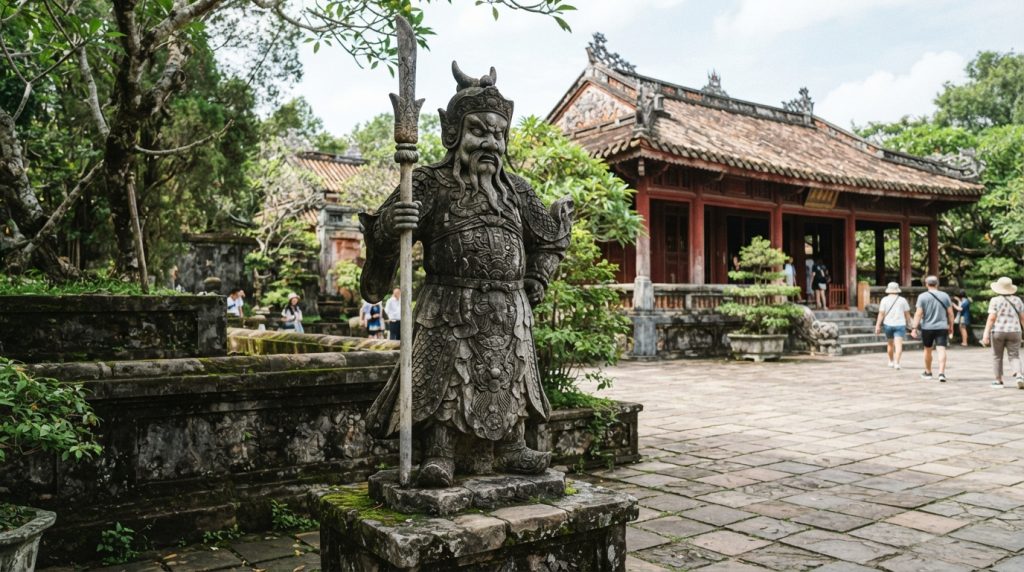
The tuk-tuk is one of Thailand’s most recognizable forms of transport and, for many travelers, also one of the first real experiences with the rhythm of its cities. More than just a vehicle, it is part of the urban landscape of Bangkok, Chiang Mai, Ayutthaya and other destinations where moving between markets, temples and chaotic avenues is part of the trip to Thailand.
However, taking a tuk-tuk is not always the cheapest or most comfortable option. Sometimes it pays off for speed on short journeys, local experience or to avoid walking in the heat, but at other times a metered cab, the metro or a transportation app can work out better. Knowing when to use it and how to negotiate the price makes all the difference.
During a trip in Southeast Asia you will use buses, trains, ferries and even motorcycles or bicycles in some areas. Even so, the tuk-tuk remains the most emblematic vehicle for short urban trips, especially in busy tourist areas. In Bangkok, for example, seeing it is constant, and trying it at least once is usually part of the experience.
What is a tuk-tuk and why is it still so popular?
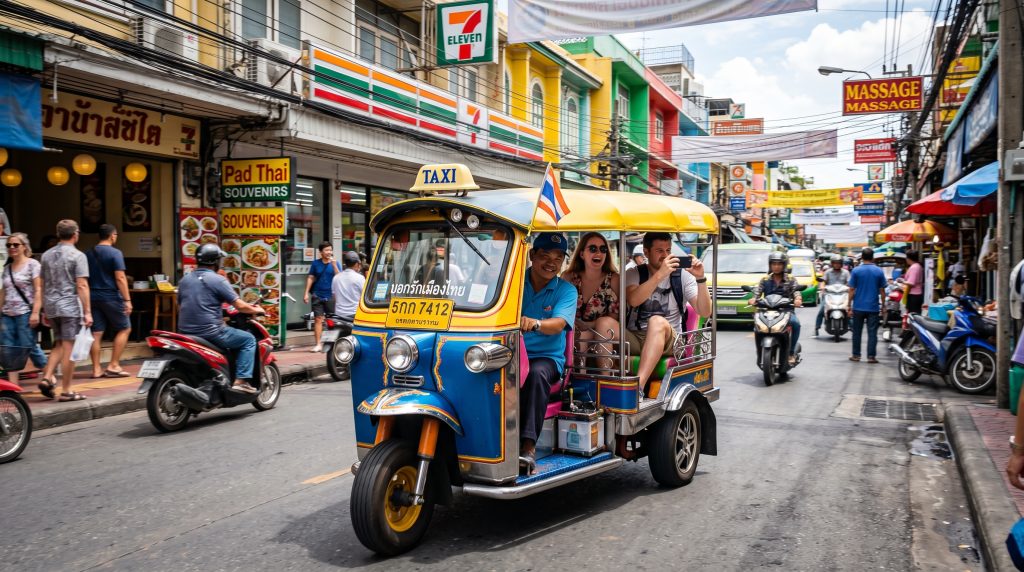
A tuk-tuk is a small motorized tricycle designed to move passengers over short distances. Its open structure, maneuverability and constant presence in urban areas made it a practical solution in dense streets with slow traffic and many stops.
Its popularity is not only explained by its usefulness. It also has a strong cultural and touristic component. The sound of the engine, the proximity to the street and the feeling of being integrated into the orderly chaos of the city make many travelers remember it as an experience as typical as visiting a night market or eating at a street stall.
However, it is worth looking at it in perspective. It does not always compete well in price against other means of transport, nor does it stand out in terms of comfort when it is very hot, there is pollution or traffic is at a standstill. It works better as a one-off option than as the main system for getting around all day.
Brief history of the tuk-tuk in Thailand
The origin of the tuk-tuk is related to the old rickshaws, light two-wheeled carts pulled by one person that spread throughout Asia between the late 19th and early 20th centuries. In cities with lively streets and short commutes, these vehicles became a common transportation solution.
Over time, these systems evolved. The mechanization of urban transport completely changed the model, and manual carts gave way to faster motorized versions with greater capacity for daily use. This transition did not happen all at once, but it was decisive for the emergence of the modern tuk-tuk.
From manual trolley to motorized tricycle
Following the spread of small engines and light vehicles in the 20th century, the concept of the motorized tricycle began to gain ground. Europe and Asia developed similar solutions for urban and freight transport, and the format became well suited to narrow streets and short distances.
In this context, three-wheeled models inspired by popular motorcycles helped define today’s tuk-tuk. Thailand integrated it into its urban daily life until it became an inseparable image of cities like Bangkok. Today it is still useful, although it coexists with subways, cabs, motorcycles and digital platforms.
When is it worth taking a tuk-tuk?
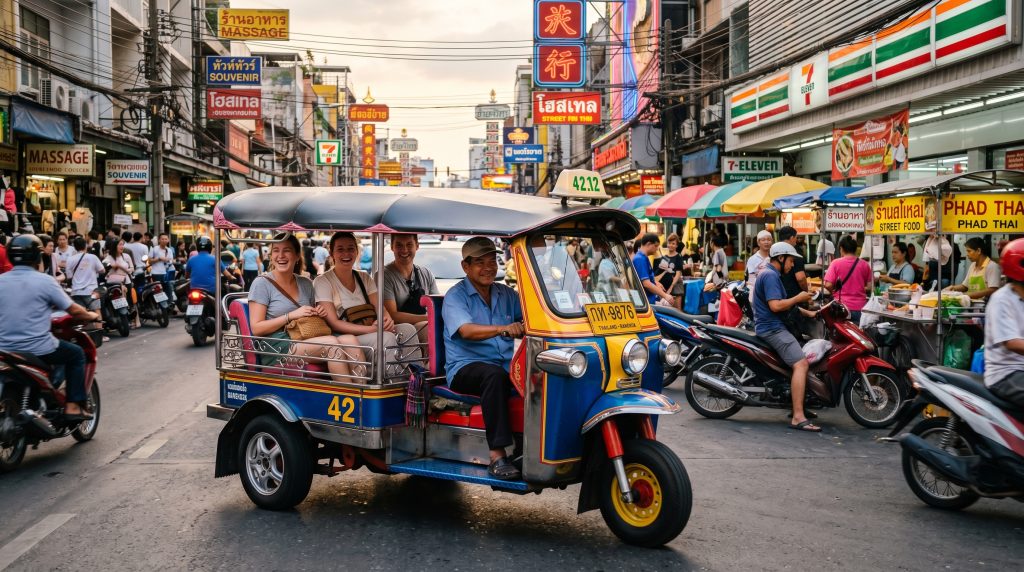
The tuk-tuk makes sense especially for short distances, when you don’t want to walk, you need to go from one nearby point to another or you want to live a different local experience. In tourist areas with many stops, it can be practical to link market, temple and accommodation without wasting too much time.
It can also fit well at night, when the heat drops a little and the urban atmosphere changes. On short trips with little traffic, the ride is usually more pleasant and allows you to enjoy the city in a more open way than in a closed car.
On the other hand, for long journeys or during rush hour, it is worth thinking twice. Comfort drops a lot when you are stuck between cars, smoke and heat. In such cases, cab, BTS, MRT or car-by-app are usually more reasonable options.
Advantages and disadvantages compared to other transports
Before boarding, it is a good idea to compare it with the real alternatives around you. Many travelers assume that it will always be the cheapest local transport, and this is often not the case in tourist areas.
These are its main differences compared to other means of transportation:
- More local experience than a cab or a car requested by app.
- Less comfort than a closed vehicle with air conditioning.
- Better for short distances than for long distances.
- Variable price, as it is usually negotiated before departure.
- Worst option in heavy rain or heavy traffic.
- Good maneuverability on busy streets.
In short, its value is more in the punctual utility and experience than in pure savings. If you use it with that in mind, it tends to leave better memories and less frustration.
How to negotiate the price without overpaying
Negotiating is a normal part of the process when you take a tuk-tuk in Thailand. You don’t need to turn it into a battle, but you do need to settle the amount before you start. If you get in without agreeing on the fare, it is easy to end up paying more than expected.
The key is to keep it simple. State your destination, ask the price, mentally compare with other options and accept only if it fits. A short, clear negotiation usually works better than arguing too much. When the price skyrockets, the most effective thing to do is to say thank you and look for another vehicle.
It also helps to carry change and to know that in very touristy areas the first price will rarely be the best. It is not a matter of bargaining by system, but to avoid inflated rates due to lack of reference or haste.
Practical tips before boarding a tuk-tuk
There are several simple precautions that greatly improve the experience. Most of the problems with tuk-tuks do not come from the vehicle itself, but from misplaced expectations: thinking that it will be cheap, comfortable or ideal for any journey.
These tips will help you move more judiciously:
- Avoid rush hour, because the heat, noise and pollution are more noticeable than in other modes of transport.
- Agree on the price before leaving and confirm that you both understand the destination.
- Don’t assume it will be cheap; sometimes a cab or an app works out better.
- Use it for short distances, where it really makes sense.
- Carry loose cash for hassle-free payment at the end of the trip.
- Holds backpack, cell phone and camera securely, especially on busy streets.
Applying these guidelines avoids most uncomfortable situations and allows you to enjoy the ride for what it is: a curious and useful way to get around, not a luxury or an unavoidable trap.
What to avoid when taking a tuk-tuk in tourist areas
One of the most common mistakes is to accept “special” or very cheap tours with stops included. Sometimes the driver proposes detours to stores, agencies, tailors, massages or excursions. It may seem like a help, but many times it is in response to commissions and ends up lengthening the trip or making the experience more expensive.
You should also be wary of messages such as “that temple is closed today” if the alternative is to take you somewhere else. When a plan changes too much in the middle of the journey, the wise thing to do is to stop and review the situation. In destinations with a lot of tourism, this type of scene has been going on for years.
It doesn’t mean that all drivers are the same. Most simply offer a straightforward service, but knowing how to spot these commercial detours helps you stay in control of your route and budget.
Is it safe to travel by tuk-tuk in Thailand?
In general, the tuk-tuk is safe for normal tourist use if you choose short trips, agree on the price beforehand and keep an eye on your belongings. It does not usually pose serious problems, but it does require more exposure to the environment than a closed car.
The feeling of safety depends very much on the traffic, the way you drive and the time of day. In very busy avenues or with rough driving, it can be more uncomfortable than dangerous, although it is advisable to sit correctly and not to put your body or luggage out too far.
If you are traveling with small children, a lot of luggage or are looking for maximum comfort, it may not be the most practical option. For an adult who wants to try it on an occasional basis, it is usually a safe and manageable experience with a minimum of common sense.
Frequently asked questions about tuk-tuk in Thailand
Is it cheaper than a cab?
Not always. In tourist areas it can even be more expensive, especially if you do not compare or negotiate beforehand.
Can it be used to move around all day?
It is possible, but it is not usually the most comfortable or efficient. It works best on specific routes.
Is it necessary to have the address written down?
It is recommended. Having the name of the hotel or place well identified helps a lot, especially if the pronunciation generates doubts.
Is it advisable to book in advance?
No. It is usual to stop it in the street or to find it in crowded places. No prior planning is required.
Tuk-tuk in Thailand: an experience that should be experienced with a head.
Trying a tuk-tuk in Thailand is still worthwhile if you understand what it is for and what its limits are. It is an authentic way to feel the city, see its rhythm from the inside and add a very local moment to the trip.
The best strategy is simple: use it on short routes, avoid complicated hours, negotiate beforehand and do not accept unnecessary detours. This way you will enjoy the experience without idealizing it or getting avoidable surprises. If you are going to pass through Bangkok or any other big Thai city, going up at least once is almost mandatory.