Thailand is located in a tropical zone. For this reason, you can expect to find the typical monsoon climate present in any area near the equator. As we saw in our article on the best time to travel to Vietnam, Thailand also has two distinct seasons: the dry season and the rainy season. Furthermore, during the monsoon (May to September), downpours are usually intense and short. If you travel to Thailand during the summer, expect to encounter rain every day, especially in the afternoon, although these will almost certainly be intense showers that will not last more than 2 or 3 hours.
Two Very Distinct Climate Zones
Although Thailand’s climate can be categorized as tropical, there are two very distinct types of climates: the tropical monsoon climate and the tropical savanna climate.
The Thai monsoon climate is very common in areas near the sea, where greater evaporation and relative humidity lead to more rainfall throughout the year, and even more so during the rainy season. In Thailand, this climate is found on the Malay Peninsula, which is surrounded by the Burma and Andaman Seas on one side and the Pacific Ocean (Gulf of Thailand) on the other. The city of Bangkok is also within this climatic influence zone.
Regarding the tropical savanna climate, it is present in the center of the country, in the area north of Bangkok. Due to its inland nature and latitude, the north, northeast, central, and eastern parts of Thailand experience a long period of warm weather. During the hottest time of the year, temperatures often reach 40 °C or more, with the exception of coastal areas, where sea breezes moderate temperatures.

Top image: Thai climates
High Season, the Coolest Period
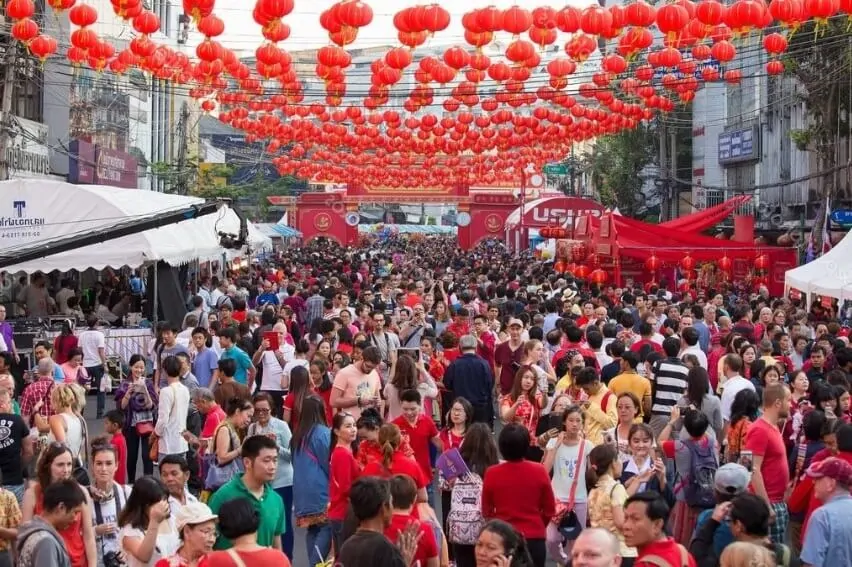
Top image: Crowds during Chinese New Year (February)
Pros: moderate temperatures.
Cons: higher prices and crowds.
If you are accustomed to the relatively cool summers enjoyed in the north and northeast of the Iberian Peninsula and wish to avoid the heat as much as possible, plan your trip to Thailand during the months from November to February. However, this is when the country sees the most travelers, and this period is considered “high season.” Prices will be higher compared to other times of the year, and you will encounter more people than during other periods.
Low Season, Rainy and Monsoon Period
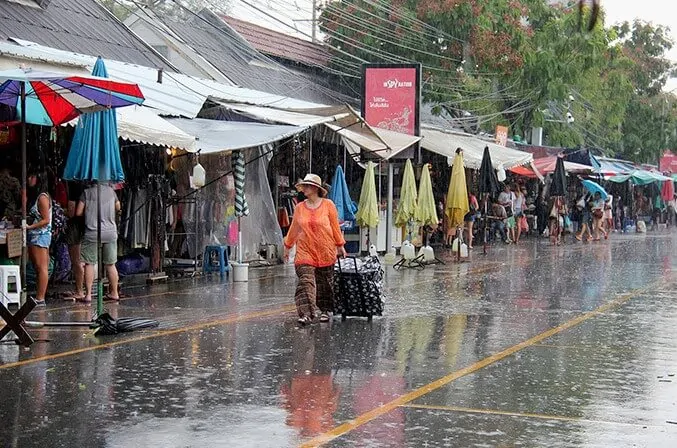
Top image: Typical intense downpour in Bangkok (August)
Pros: lower prices and fewer tourists.
Cons: hotter weather and daily downpours.
However, if you can only take your vacation during the months of June, July, August, and September, and therefore will be traveling to Thailand during this period, expect to encounter slightly more heat and daily monsoon rains. The rains are more pronounced in Bangkok and the Malay Peninsula (southern part of the country), so expect short, intense downpours daily. Nevertheless, as it is low season, you will find prices somewhat more moderate and fewer crowds of tourists.