The Mekong Delta is one of the most unique regions in southern Vietnam: a vast network of rivers, canals, rice paddies, orchards, and cities where daily life remains closely tied to the water. Although it’s possible to visit from Ho Chi Minh City on a day trip, spending two or three nights there allows you to better understand the area and visit places like Cái Bè, Cần Thơ, the Cái Răng floating market, the Trà Sư flooded forest, and Châu Đốc.
For a first visit, we recommend a three-day itinerary starting in Ho Chi Minh City that combines road trips, boat rides, bike rides, and some of the most iconic experiences in the delta. At One More Destination, we can incorporate this area into our custom Vietnam tours, adjusting the stages and pace to fit the rest of your trip through the country.
What is the Mekong Delta and why is it worth visiting
?
The Mekong is one of Asia’s great rivers. It originates on the Tibetan Plateau and flows for about 4,900 kilometers before reaching the sea, crossing or bordering the territories of China, Myanmar, Laos, Thailand, Cambodia, and Vietnam. In China, it is known as the Lancang, while its name changes slightly as it flows through Southeast Asia.
Upon reaching southern Vietnam, the river branches into numerous tributaries and channels before flowing into the sea. This complex network gives rise to the traditional Vietnamese name Cửu Long, or “River of the Nine Dragons,” a historical reference to its main tributaries.
The delta is also one of Vietnam’s major agricultural regions. For centuries, the river’s sediment, abundant water, and tropical climate have fostered the cultivation of rice, tropical fruits, coconuts, and numerous vegetables, as well as fishing and aquaculture. For travelers, this means markets, orchards, small boat docks, family-run workshops, and a cuisine deeply rooted in local produce.
How to Plan a Trip Through the Mekong Delta
The easiest way to start is from Ho Chi Minh City, formerly Saigon. Cần Thơ is located approximately 170 kilometers to the southwest and serves as one of the delta’s main urban and logistics hubs, but it’s worth stopping first in rural areas such as Cái Bè or Bến Tre.
Anyone planning a comprehensive tour of the south can combine a visit to the delta with a few days in Ho Chi Minh City. The contrast is fascinating: in just a few hours, you go from a major metropolis to roads winding through rice paddies, secondary canals, and communities where boats are still an integral part of daily life.
| Day | Orientation Route | Highlights |
|---|---|---|
| 1 | Ho Chi Minh City – Cái Bè – Tân Phong – Cần Thơ | Canals, orchards, traditional houses, and bicycles |
| 2 | Cần Thơ – Cái Răng – Trà Sư – Châu Đốc | Floating market, boat ride, and flooded forest |
| 3 | Châu Đốc – Cham communities – Ho Chi Minh City | River life, local culture, and return by road |
This itinerary is quite packed, so three days is a good minimum for those who want to explore different landscapes without limiting themselves to a quick excursion. With four or five days, you can take things at a more leisurely pace and include Bến Tre, Sa Đéc, or other rural areas.
Day 1: From Ho Chi Minh City to Cần Thơ via Cái Bè
The first leg of the journey begins with an early departure from Ho Chi Minh City toward Cái Bè, in Tiền Giang Province. The appeal of this area should no longer be limited solely to the image of its historic floating markets: it’s well worth a visit for its small canals, fruit orchards, traditional houses, and workshops linked to local agriculture.
Once at the river, a boat ride in a small vessel allows you to reach places that go unnoticed from the road. It is precisely when you leave the major transportation routes behind that the Mekong’s most characteristic landscape comes into view: homes along the water’s edge, private docks, tropical vegetation, and crops separated by narrow canals.
Traditional Houses and Rural Life in Cái Bè
Cái Bè preserves old wooden houses that offer a glimpse into the domestic architecture of the delta. Some combine Vietnamese elements with influences incorporated during the 19th and 20th centuries and are surrounded by gardens with fruit trees such as rambutan, longan, mango, or durian, depending on the season.
Rather than trying to rack up visits, it’s worth taking the time to explore the rural roads and observe how the area is laid out. Cycling is especially pleasant on the quiet stretches, although it’s a good idea to adjust your route to account for the heat and rain, which are common in this tropical region.
Tân Phong Island
Across from Cái Bè lies Tân Phong, a river island covered with orchards and small villages. Its paths allow for walks or bike rides among homes, crops, and canals, offering a much more leisurely view of the delta than what can be seen from a main road.
Some tours include fruit tastings, small family workshops, or demonstrations of traditional music from southern Vietnam. The specific activities may vary, so it’s best to think of these stops as opportunities to experience local life rather than as a fixed list of attractions.
Next, continue on to Cần Thơ, the most important city in the delta and the best base for visiting Cái Răng first thing in the morning. It’s best to stay near downtown or the Ninh Kiều pier, since you’ll need to get up before sunrise the next day.
Day 2: Cái Răng Floating Market and Trà Sư Forest
The second day begins very early. The Cái Răng Floating Market remains primarily a wholesale market, and most of the activity tends to take place during the early morning hours. That’s why it makes little sense to arrive when most of the trading has already wrapped up.
A good guideline is to leave Cần Thơ around 5:00 or 5:30 a.m. and arrive at the market area between sunrise and approximately 8:00 a.m. Exact times may vary depending on the day, the season, and the level of activity, but getting there early completely changes the experience.
What the Cái Răng Floating Market Is Like Today
Cái Răng remains one of the most recognizable places in the delta, although its appearance has changed with improvements in road transportation. It should no longer be imagined as a permanent gathering of hundreds of small canoes: much of the trade is now carried out by boats that deal in wholesale fruit and agricultural products.
One particularly curious tradition involves placing a sample of the merchandise on a pole raised high on the boat so that buyers can identify it from a distance. Small boats carrying drinks, coffee, or breakfast also make their way among the commercial vessels, turning the morning cruise into an opportunity to watch the river as it awakens.

After visiting the market, it’s worth continuing on to one of the nearby canals or visiting a small workshop that specializes in rice and noodles. The cuisine of the delta is closely tied to this grain, and here it’s common to find different varieties of rice noodles served in soups, stir-fries, or as a side dish.
Traditional monkey bridges
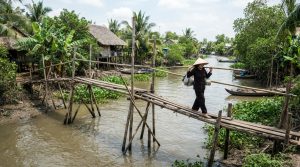
In rural areas, you can still find what are known as “cầu khỉ” or monkey bridges—very simple structures traditionally built of wood or bamboo to span narrow canals. For generations, they served as a practical solution in a region crisscrossed by countless waterways.
The modernization of roads and infrastructure has led to many of these bridges being replaced by sturdier ones. Those that remain today serve both a practical purpose in certain locations and hold cultural value, so they should not be viewed as attractions created exclusively for tourists.
From Cần Thơ to the Trà Sư Flooded Forest
From Cần Thơ, the route continues toward An Giang Province to visit Trà Sư, a flooded forest dominated by cajeput trees. The landscape is very different from that of the Mekong’s wide branches: here, the boat travels through narrow channels covered with aquatic vegetation and surrounded by a forest that appears almost impenetrable.
The experience depends largely on the water level. The rainy season typically offers a particularly lush landscape and makes it easier to navigate some flooded areas, while the presence and visibility of birds vary depending on the season and time of day. It’s best to avoid expecting specific sightings and simply enjoy the ecosystem itself.

Châu Đốc and Mount Sam
After Trà Sư, the most convenient place to spend the night is Châu Đốc, very close to the Cambodian border. If time permits, the area around Mount Sam offers a beautiful panoramic view of the rice paddies of An Giang, especially in the late afternoon light.
The area also has significant religious significance. Temples and pilgrimage sites associated with various traditions are concentrated around the mountain, revealing another facet of a delta where Vietnamese, Khmer, Chinese, and Cham influences coexist.
Day 3: Châu Đốc, Cham communities, and return to Ho Chi Minh City
You can spend the last day exploring the riverine surroundings of Châu Đốc before heading back. In this part of the Mekong, there are aquaculture farms and communities settled along the river, so a boat trip is once again the best way to experience the landscape.
Cham communities, an ethnic minority with their own history and traditions, also live in the region. Part of the Cham population in the An Giang area practices Islam, which is evident in their mosques and customs. Visits to these areas should be conducted with respect for religious sites and the daily lives of the residents, taking care not to turn the villages into mere photo opportunities.
From Châu Đốc, the drive back to Ho Chi Minh City takes most of the day. If your itinerary continues on to Cambodia, you can also travel from this area to Phnom Penh via river and land routes, although it’s a good idea to check schedules, border crossings, and immigration requirements before your trip.
When to travel to the Mekong Delta
The delta can be visited year-round, but the landscape changes noticeably with the seasons. Between approximately December and April, a drier period predominates, while between May and November, rainfall is more frequent. There is no single perfect time to visit ; the choice depends on the type of experience you’re looking for.
The dry season makes cycling and overland travel easier. During the rainy months, however, the vegetation becomes more lush, and certain wetlands, such as Trà Sư, can look their most vibrant. Tropical rains also do not necessarily mean continuous rainfall throughout the day.
Practical Tips for Visiting the Delta
A tour of this region involves a mix of boats, vehicles, walking, and, in some cases, biking. That’s why it’s best to travel light, wearing breathable clothing and shoes that can get wet. A lightweight raincoat and a waterproof bag for your documents, cell phone, and camera can also come in handy.
The heat and humidity are constant for much of the year. It is advisable to bring water, sunscreen, and insect repellent, especially in areas with vegetation and wetlands. In addition, markets and river activities start early, so staying close to the departure point helps avoid unnecessary travel at dawn.
- Get up early in Cái Răng: business is busiest during the early morning hours.
- Don’t plan too many stops: distances in the delta may seem short on the map, but travel can be slow.
- Protect your devices: splashes can occur on small boats.
- Respect temples and communities: dress appropriately and ask for permission before photographing people.
- Check schedules: transportation, boats, and activities may vary by season.
Above all, be sure to set aside time for observation. The Mekong’s appeal lies as much in its major sites as in the journeys between them: the houses opening out onto the river, the orchards, the small ferries, the markets, and the daily rhythm of a region that continues to revolve around the water.
One day, two days, or three days in the Mekong Delta?
A day trip from Ho Chi Minh City gives you a first taste of the area—usually around Mỹ Tho or Bến Tre—but requires spending quite a bit of time on the road. With two days, you can stay overnight in Cần Thơ and visit Cái Răng at the right time of day, which greatly enhances the experience.
In three days, you can travel as far as An Giang, include Trà Sư and Châu Đốc in your itinerary, and get a much more complete picture of the region. If the delta plays an important role in your trip, four or five days will allow you to slow down and explore rural areas in greater depth. The best itinerary is one that balances sightseeing and travel time, not one that crams in the most places.
A leisurely journey to discover southern Vietnam
The Mekong Delta is not just a single landscape or a series of floating markets. Cái Bè, Cần Thơ, Trà Sư, and Châu Đốc showcase very different ways of interacting with the river, ranging from trade and agriculture to wetlands and border communities.
For a first visit, three days provide a well-rounded tour from Ho Chi Minh City. If this is part of a longer trip through Vietnam, it’s worth adjusting the itinerary to fit the time available, the time of year, and each traveler’s preferences so that the delta is an experience in its own right rather than a rushed visit.