Changing money in Vietnam is one of those things that seems simple until you arrive at the airport with dollars or euros and realize that the decision of where and when to change can cost – or save – you considerable money. The Vietnamese dong (VND) is not readily available outside the country, so the strategy starts on Vietnamese soil.
At One More Destination we have been organizing trips in Vietnam for years and this is one of the topics our clients ask us most about before leaving. This guide outlines what works in 2026: what options you have, what gives the best change and what mistakes to avoid.
The Vietnamese dong: the basics you need to know
The official currency of Vietnam is the Vietnamese dong (VND). It only exists in banknotes – there are no coins in circulation – which makes day-to-day life quite simple. Banknotes range from 1,000 VND to 500,000 VND, and from 10,000 VND upwards are made of polymer: waterproof and difficult to counterfeit.
The indicative exchange rate in 2026 is approximately 27,000-27,500 VND for 1 euro. With this exchange rate, the math is simple: a 100,000 VND bill is worth about 3.6 €, and a 500,000 VND note is about 18 €. The most common on a daily basis are 100,000 and 200,000 VND banknotes.
Important tip: Damaged bills, with tears, marks or pronounced folds are accepted with worse change or are directly rejected in some jewelry stores. If you bring euros or dollars in cash, try to make sure they are in good condition. Dollar bills from before 2009 also tend to be worse priced.
| Ticket | Approx. equivalence in euros | Usual use |
|---|---|---|
| 10,000 VND | ~0,36 € | Gratuities, parking |
| 50,000 VND | ~1,85 € | Street food, local transportation |
| 100,000 VND | ~3,65 € | Most commonly used in everyday life |
| 200,000 VND | ~7,30 € | Restaurants, markets |
| 500,000 VND | ~18,20 € | Large payments, hotels |
Where to exchange money in Vietnam: all options
You have four main ways to get your hands on Vietnamese dong. Each one has its own time and logic.
At the airport: just enough for the first day
Arriving in Hanoi, Ho Chi Minh or Da Nang you will find exchange houses in the arrivals area. The exchange rate is worse than in the city, but not dramatically. Our recommendation is to change between 50 and 100 € at the airport, enough for the cab or grab to the hotel, the first night and some food while you get your bearings.
Don’t change more than necessary here. Once in the center, you will have better options with significantly more favorable rates.
Jewelry stores: the best change in town
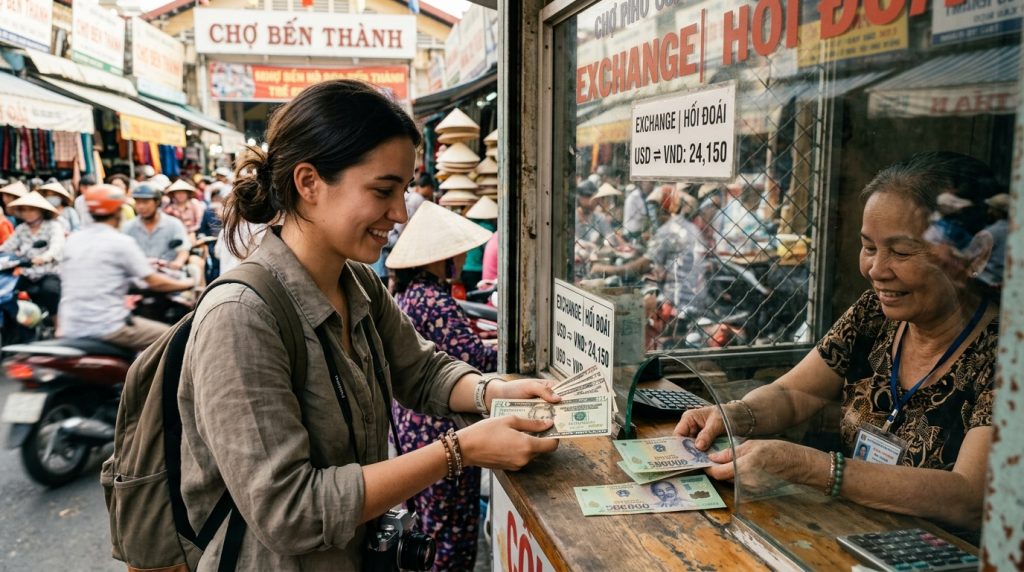
Jewelry stores are by far the place where you will get the best exchange rate in Vietnam. They operate seven days a week, don’t ask for your passport and their rate usually beats that of banks. The exchange rate they offer is displayed on luminous screens at the entrance of the store, so you can compare before entering.
In Hanoi, the reference is Hang Bac Street, in the historic center, where there are several long-established jewelry stores exchanging foreign currency for tourists. In Ho Chi Minh City, you will find them in the Ben Thanh district. If you carry several hundred euros, the difference with respect to the bank can be significant.
You have to know how the process works: you arrive, see the change on the screen, indicate how much you want to change and they show you on a calculator the exact amount you will receive in dong. If you accept, an employee counts it with a bill counting machine in front of you. Always count the wad yourself before you leave. It is customary, expected and completely normal.
Banks: safe, but with longer opening hours and more formalities
Vietnamese banks are the safest option for large amounts. Vietcombank, VietinBank, BIDV and Techcombank offer foreign exchange to tourists at official regulated rates. Their exchange rate is good, although generally somewhat lower than jewelry stores. The drawback is the opening hours – they usually close between 11:30 and 13:00 and do not open on public holidays – and that in some cases they ask for a passport for larger transactions.
For medium quantities and if you are not in a hurry, they are a valid alternative. For the day to day, jewelry stores win.
Hotel: comfortable but expensive
Hotels offer currency exchange as a complimentary service, but their rate is usually the worst of all options. Use it only if you need dong urgently after business hours or in an area where there are no other options at hand. Convenience comes at a price.
ATMs in Vietnam: how to use them without losing money
Withdrawing money from the ATM is a valid alternative, especially if you are traveling with a card designed for foreigners. Most ATMs in Vietnam charge a withdrawal fee of between 20,000 and 55,000 VND ( approximately 0.75-2 €) per transaction.
Some banks have a better reputation among travelers for avoiding or minimizing fees: Vietcombank, BIDV and Techcombank are the most widespread and reliable. TPBank was popular for years for not charging fees, but since mid-2025 it applies a fee of VND55,000 per withdrawal. Others such as ACB, Eximbank and Saigon Bank have less coverage but some travelers report lower fees.
Withdrawal limit: Most ATMs allow withdrawals between 2 and 5 million VND per transaction (between 75 and 185 €). If you need more, you will have to make several withdrawals or go directly to the bank.
An important detail: some ATMs ask you if you want the charge to be made in euros instead of dong (a service called DCC or dynamic currency conversion). Always refuse this option. The exchange rate applied by the ATM in such cases is considerably worse than that of your bank.
Wise, N26 and travel cards: the digital alternative
In recent years, Wise and N26 have become the favorite choices for frequent travelers to manage money in Vietnam.
Wise allows you to exchange euros to dong with a commission of about 0.9%, well below the usual bank fees, and withdraw up to €200 per month at ATMs at no additional cost. N26, on the other hand, allows several free withdrawals per month with no limit on the amount. Many travelers combine both cards: they use Wise for the first withdrawals and N26 as a backup when the free limit is exhausted.
If you are traveling for several days or weeks in Vietnam, having at least one of these cards can mean real savings compared to the usual bank fees.
Paying by credit card in Vietnam
Vietnam has upgraded its payment infrastructure considerably in recent years. In hotels, upper-middle-end restaurants, shopping malls and tourist stores, Visa and Mastercard are widely accepted. In the local environment – markets, street stalls, tuk-tuk or xe om transport, neighborhood restaurants – cash is still essential.
The main disadvantage of paying by card is that many establishments apply a surcharge of 2-3% on the amount. In high category hotels or large chains this does not usually happen, but in family businesses it is quite common. Ask before paying to avoid surprises.
Comparative summary: where to switch depending on your situation?
| Option | Exchange rate | Availability | Recommended for |
|---|---|---|---|
| Jewelers | ⭐⭐⭐⭐⭐ The best | 7 days, extended hours | Large or frequent changes |
| Banks (Vietcombank…) | ⭐⭐⭐⭐ | M-F, limited hours | Large amounts with security |
| ATMs + Wise/N26 | ⭐⭐⭐⭐ | 24h (ATMs) | Travelers with travel cards |
| Airport | ⭐⭐⭐ | Arrival | Only the amount for the first day |
| Hotel | ⭐⭐ | 24h | After hours emergencies |
Practical tips to avoid losing money on exchange
- Do not change in Spain before leaving. The exchange rate at airports and Spanish exchange offices for the Vietnamese dong is very unfavorable. Better to arrive with euros or dollars in cash.
- Dollars also work. If you have dollars, you can exchange them in Vietnam without any problem. In fact, some tourist services and hotels accept them directly. Tickets must be after 2009 to get the best exchange rate.
- Always count the money before leaving the establishment. In jewelry stores as well as in exchange houses, counting the wad is normal and expected. Never leave without doing it.
- Bring banknotes in good condition. Banknotes with tears, stains or marked folds are priced lower or rejected outright.
- Rejects dynamic conversion in ATMs. If the cashier offers to charge you in euros, always say no.
- Always have some cash on you. On rural routes, in local transportation or in markets, cash is still the only means of payment. Don’t rely solely on the card.
If you have any doubts before your trip or want us to help you organize every detail of the tour, at One More Destination we design tailor-made trips to Vietnam. We have been in the country for years and know firsthand where the experience changes for the better.