Vietnam surprises quickly. Whether you arrive for the first time in Hanoi, land in Ho Chi Minh City or travel the country from north to south: in a few hours you start to see cultural, linguistic and social details that are almost unlike anything you know in Europe or Latin America.
This article gathers 10 curiosities of Vietnam updated to 2026 that help to better understand the country before traveling. It is not a list of clichés, but a selection of everyday, historical and cultural features that usually catch the visitor’s attention and also explain quite well how Vietnam works on the inside.
Curiosities of Vietnam that you should know before you travel
Vietnam changes fast, but maintains many customs very visible in the street, in the way of speaking, in the food and in daily life. That mix between accelerated modernization and very present tradition is part of its charm.
These curiosities are not a substitute for a practical travel guide, but they do give you more context to interpret what you see. And that makes the trip much more enjoyable, because you understand better why certain things happen and what they mean in their local context.
1. Ao Dai remains a vivid national symbol.
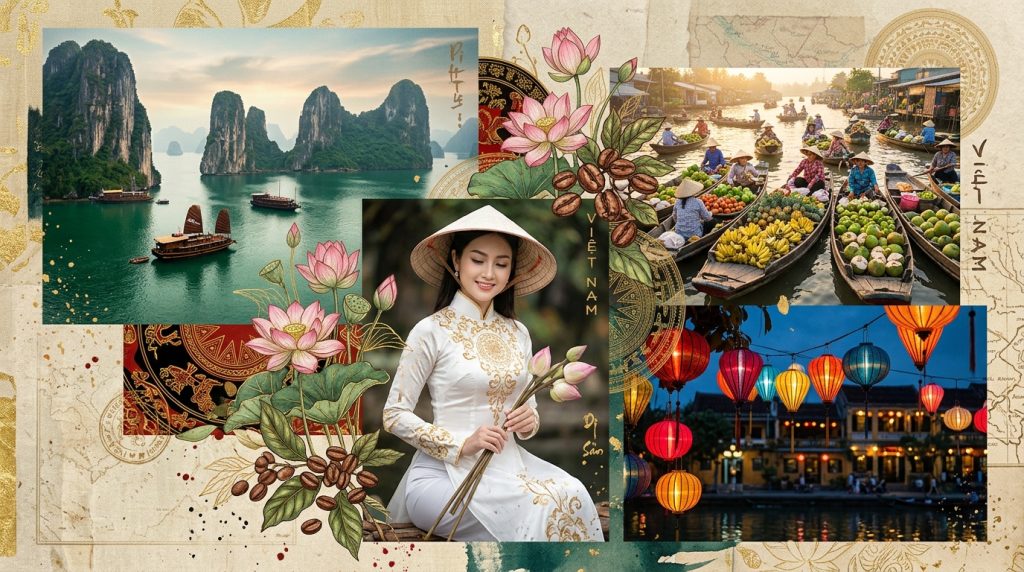
If there is a garment that represents Vietnam, it is the Ao Dai. Its stylized silhouette, its elegant drape and its presence in celebrations, official events, graduations or photo shoots make it one of the most recognizable images of the country.
Although in the eyes of the traveler it may seem a garment reserved for big occasions, in Vietnam it also has a more everyday role. In some schools, corporate events and family ceremonies it is still a common option, and in cities like Hanoi or Hue it is easy to see it in very different contexts. The result is curious: a traditional garment that does not look like it belongs in a museum, but is integrated into today’s life.
Along with this elegance coexists another much more informal detail: comfortable street clothes. In residential neighborhoods, markets or short journeys it is still normal to see very homemade outfits worn with total naturalness. It does not respond to a lack of etiquette, but to a different relationship with neighborhood life, heat and daily routine.
In short, Vietnam has something rare: the visual tradition is still present without feeling forced. That’s why the contrast between Ao Dai and more domestic clothing is so striking to the visitor.
2. Traffic seems chaotic, but it has its own logic.
The traffic in Vietnam makes an impact from minute one. Thousands of motorcycles, continuous crossings, seemingly impossible turns and a constant flow of vehicles make one think that disorder reigns. However, behind this first impression there is a quite recognizable informal system.
The key is in the rhythm. On many streets, especially in big cities, traffic does not work so much by sudden pauses as by constant movement, anticipation and visual negotiation. Driving is done by looking at the surroundings, measuring gaps and trusting that others have also seen you. For those who are not used to it, crossing the street may seem like a test of faith.
In addition, the motorcycle remains the dominant vehicle for a practical reason: it is agile, affordable and better adapted to the urban fabric. Added to this is the growth of private cars, deliveries, transport applications and new infrastructures, which makes traffic increasingly dense at certain times of the day.
The important thing for the traveler is to understand this:
- Do not try to run across; it is better to keep a steady and predictable pace.
- Avoid thinking in European terms; here the flow is interpreted differently.
- The horn does not always mean anger; many times it only warns of presence.
It may seem exhausting at first, but after a few days you begin to see that this apparent chaos has unwritten rules.
3. Vietnamese is more difficult than it looks.
Many travelers believe that Vietnamese will be accessible because it is written in Latin characters. In practice, the opposite is true: being able to read the letters does not mean being able to pronounce well or understand the real meaning of a word.
The big obstacle is that it is a tonal language. A small change in intonation can completely alter the meaning, and for a non-native speaker these differences are often difficult to perceive at first. In addition, many words are short and pronunciation requires more hearing than intuition.
The grammar, on the other hand, often seems more straightforward than in other Asian languages. That helps, but it doesn’t solve the main problem: if you mispronounce, you may not be understood even if you think you’ve said the right word. It’s a very common experience for any foreigner trying to learn the basics.
Even so, memorizing a few simple expressions is worthwhile. A greeting, a polite formula or knowing how to say thank you makes a big difference in the interaction and shows interest in the local culture.
4. Its current script uses the Latin alphabet, but it was not always like that.
One of the surprises of Vietnam is that its current writing system is based on the Latin alphabet. For the visitor this makes it much easier to read signs, street names, menus or transport applications, even if the pronunciation remains complex.
But this situation is relatively recent in historical terms. For centuries, other writing systems coexisted, linked to Chinese influence and the country’s own cultural evolution. The adoption of Romanized writing transformed literacy and changed the relationship between spoken and written language.
What is interesting is that this change did not erase the past. On the contrary: Vietnam’s linguistic history remains an important part of its identity. If you visit museums, temples, ancient documents or heritage sites, you will see that the country retains traces of these earlier stages.
For the traveler, this translates into a clear advantage: you can read signs and names with visual ease. But it is important not to confuse reading with comprehension, because seeing the letters is not the same as mastering the language.
5. Nguyen is everywhere
If you travel to Vietnam, you will find the surname Nguyen over and over again. In hotels, reservations, driver profiles, invoices, restaurants or local contacts it appears with a frequency that surprises the first-time traveler very much.
It is neither a coincidence nor an exaggeration. Vietnam concentrates a huge number of people with that surname, to the point that many travelers end up joking that half the country has the same surname. There are historical, political and dynastic reasons that explain how certain surnames became so widespread over time.
This even has a practical effect: the full name matters much more than the surname alone. To differentiate people, understanding the order of the name and paying attention to how they present themselves is much more useful than looking at the surname alone, as we would do in other countries.
It is a good example of how a seemingly minor curiosity ends up teaching something important about Vietnamese history and identity.
6. The name Vietnam has more historical significance than it seems.
The word Vietnam is not just a geographic label. As with many Asian country names, it carries centuries of history, regional influences, political changes and different ways of naming the territory over time.
Before the current name, there were other names linked to different historical periods. That explains why, when you start reading about the country, old terms or names used in imperial, colonial or administrative contexts appear. It’s not just a scholarly detail: understanding those names helps to understand how Vietnam has been built.
Moreover, the Vietnamese national identity has a very strong relationship with its historical continuity. That is why the name of the country is not only experienced as a cartographic reference, but also as a form of cultural and political affirmation.
For the traveler, this context provides something valuable: behind every place name, monument or historical reference there are often more layers of meaning than meets the eye.
7. Asking if you’ve eaten is almost a form of caring.
In Vietnam, food occupies a central place in social life. Not only because of the quality and variety of its cuisine, but because eating also functions as a form of relationship, courtesy and mutual care.
It is therefore not surprising that there are everyday expressions that, translated literally, sound closely linked to the act of eating. More than a strict question about whether you have had lunch or dinner, they are often equivalent to an affectionate “how are you doing? It is a close way of taking an interest in the other person.
This fits perfectly with a country where food is everywhere: street stalls at all hours, markets full of fresh produce, plastic stools occupying sidewalks and families sharing plates on turntables. In Vietnam, eating is rarely an isolated or hurried act; it is part of the daily fabric.
Understanding this nuance changes the traveler’s view. You no longer see only famous dishes such as pho or bun cha, but a culture where food also serves to welcome, converse and maintain ties.
8. The culture of copying and replication is still very visible.
Vietnam is one of those places where the line between original, imitation and inspiration can become blurred. In markets, shopping areas and very touristic streets it is common to find clothes, accessories, suitcases, sneakers or technology with big brand aesthetics.
What is striking is not only that there is an imitation product, but the naturalness with which it coexists with everyday commerce. For the traveler, this can be curious and even tempting because of the price, but it is advisable to adjust expectations: a cheap replica rarely offers the same quality, and it is not always worth it even if the cost is low.
There is also an important nuance. Not everything that looks “fake” is to the same degree. Sometimes they are obvious copies; sometimes they are generic products with designs inspired by well-known brands. In both cases, the recommendation is simple:
- Check finishes and materials before you buy.
- Don’t assume it’s a bargain just because of the price.
- Be aware of your country’s customs regulations if you purchase certain items.
It is part of the country’s commercial landscape, but it should be seen with a practical eye and not just as an amusing anecdote.
9. Ho Chi Minh is present far beyond the history books.
The figure of Ho Chi Minh continues to occupy a central place in Vietnam. It is not limited to a school chapter or a political reference to the past: his presence appears in portraits, official spaces, memorials, place names and historical narratives that are still very much alive.
For many visitors, this is immediately apparent when touring museums, public buildings or sites linked to 20th century history. Understanding their relevance helps to better interpret the Vietnamese national narrative and how the country explains its independence, conflicts and modern political construction.
Moreover, as with other great historical leaders, biographical data, little-known stages, travels, names used at different times and episodes that often generate curiosity accumulate around his figure. Beyond the concrete detail, the important thing is this: he is not a distant character for Vietnam, but a reference still very present.
If you’re interested in history, it’s worth not passing over this point. Understanding its role changes quite a bit the way you read many symbols of the country.
10. The term “Vietcong” alone does not explain the history of Vietnam.
Many travelers arrive in Vietnam with references inherited from movies, documentaries or Western narratives about the war. Among them, the term “Vietcong” is probably one of the best known. The problem is that using it as a general label oversimplifies a rather more complex historical reality.
Vietnam’s contemporary history includes colonization, independence movements, territorial division, war, reunification and decades of economic transformation. To reduce all that to a single word or a purely military view leaves out much of the political and social context.
Therefore, if you are going to visit museums, tunnels, memorials or former war scenes, it is advisable to do so with a more open mind. Vietnam is not only understood from the conflict. It is also understood from the resistance, the reconstruction and the speed with which the country has changed in recent decades.
It’s a good final lesson for any trip: the less you rely on inherited clichés, the richer what you discover about Vietnam.
What do these curiosities reveal about Vietnam today?
Behind these curiosities there is a very clear pattern: Vietnam combines deep history, strong cultural identity and an accelerated modernization that is noticeable in the street. That mix explains why the country is puzzling, engaging and leaves a feeling of wanting to understand it better.
It also leaves a practical lesson for those preparing the trip: the more context you bring, the less you will interpret Vietnam from simplistic filters. And that shows in everything, from how you cross an avenue to how you read a menu, a conversation or a museum.
If you are traveling soon, it is ideal to combine this cultural overview with practical information about routes, weather, money, transportation and basic customs. This way you will not only visit Vietnam: you will experience it in much more depth.
And that, in the end, is one of the best reasons to go: Vietnam is not exhausted in a list of beautiful places. It’s a country that you understand better the more you see it, and that’s precisely why it leaves such an impression.