Ayutthaya is one of the best places to gain an understanding of Thailand’s history. Brick temples, large chedis, Buddha images, and the ruins of ancient palaces now stand where a city once stood that, for more than four centuries, was one of Southeast Asia’s major political and commercial centers.
Its proximity to Bangkok makes it possible to visit on a day trip, although spending more time there allows you to explore the site at a more leisurely pace. In this guide , we’ll go over what to see in Ayutthaya, how to get there from Bangkok, how to get around, and how to plan your visit to make the most of it.
Ayutthaya and the History of the Ancient Kingdom of Siam
The city of Ayutthaya was founded around 1350 by King U Thong, who took the name Ramathibodi I upon ascending the throne. From then on, it became the second major capital of the Kingdom of Siam after Sukhothai and remained so until 1767.
Its location was carefully chosen. The historic city developed in an area surrounded by the Chao Phraya, Pa Sak, and Lopburi rivers, connected to the sea and at the same time protected by a natural network of waterways. This location facilitated both its defense and trade with other regions of Asia and with merchants arriving from much farther afield.
From the 14th to the 18th centuries, Ayutthaya became an important diplomatic, religious, and commercial center. Palaces, monasteries, and temples reflected the kingdom’s wealth, while its architecture incorporated influences from various Southeast Asian traditions.
The city’s history was also marked by conflicts with the Burmese kingdoms. Ayutthaya was occupied in 1569 and, following another offensive, was destroyed in 1767 and ceased to serve as the capital. The kingdom’s political center subsequently shifted to the Bangkok area.
The surviving ruins give a sense of the scale of that city. Due to its historical significance, the historic city of Ayutthaya was designated a UNESCO World Heritage Site in 1991.
What to see in Ayutthaya: temples and must-see places
Ayutthaya’s heritage is spread over a considerable area and is not concentrated in a single enclosed site . Some temples are located on the historic island, while others are on the other side of the rivers, so it’s advisable to plan your visits in advance.
On a first visit, we recommend focusing on a few sites that showcase the different periods and styles of the former capital. Four or five well-chosen temples usually offer a more complete experience than trying to rush through too many monuments.
Wat Mahathat and the Buddha’s head among the roots
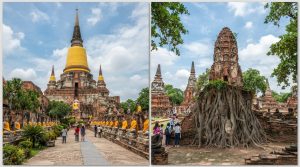
Wat Mahathat is probably the most recognizable temple in Ayutthaya. It was located in a central area of the ancient city and was one of the most religiously significant monasteries during the kingdom’s reign.
Amid its prangs, stupas, and brick walls stands its most famous image: a Buddha head nestled among the roots of a tree. When photographing it, it is important to maintain a respectful posture and avoid standing above the image of the Buddha.
Wat Phra Si Sanphet and the former royal compound
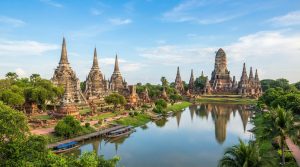
Wat Phra Si Sanphet was part of the former palace grounds and was one of the most important temples of the Ayutthaya Kingdom. Its skyline is dominated by three large, aligned chedis, which have become one of the most iconic sights in the historic park.
The complex is particularly helpful in understanding the relationship between political power and religion in the former capital. The three main stupas were built to house the ashes of various Ayutthaya monarchs.
Wat Ratchaburana and its prangs
Very close to Wat Mahathat is Wat Ratchaburana, another complex worth adding to your itinerary. It was built during the 15th century and is notable for its large central prang and the decorations still visible on some of its structures.
Its proximity to other important monuments makes it easy to combine several visits without having to travel long distances. It is also a good place to observe the Khmer-style architecture that influenced many temples in the former capital.
Wat Chaiwatthanaram, one of the most spectacular temples
Wat Chaiwatthanaram is located along the Chao Phraya River, outside the central island. It was built in the 17th century during the reign of Prasat Thong and is notable for the grandeur of its central prang and the harmony of the complex as a whole.
The arrangement of towers, galleries, and small chedis makes it particularly photogenic during the late afternoon. If your itinerary allows, it’s a good idea to save this visit for the end of the day, when the light is usually most pleasant.
Wat Yai Chai Mongkhon and its large chedi
Located southeast of the historic city, Wat Yai Chai Mongkhon remains an active monastery and offers an atmosphere distinct from that of the ruined archaeological sites. Its dominant feature is a massive chedi visible from much of the grounds.
Also noteworthy are the numerous images of Buddha scattered throughout the complex and a large reclining Buddha. The combination of historic structures and religious activity helps illustrate that Thai temples remain spiritual spaces as well as places of cultural interest.
Bang Pa-In, a unique attraction near Ayutthaya
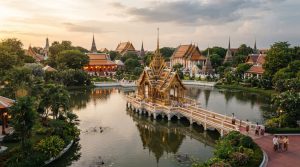
The Bang Pa-In Royal Palace is not located within the historic park, so it’s best to consider it a supplementary attraction rather than another temple in Ayutthaya. It is located south of the city and requires a separate trip.
Although the site dates back further, much of the complex that visitors see today was built during the 19th century. Its pavilions combine different architectural styles and stand in stark contrast to the medieval ruins of Ayutthaya.
How to Get from Bangkok to Ayutthaya
Ayutthaya is located approximately 80 kilometers north of Bangkok, a distance that makes it easy to visit on a day trip. If you’re planning the first few days of your trip, our guide on what to see in Bangkok will help you incorporate both cities into your itinerary.
There are different ways to make the trip, and the choice depends mainly on your budget, the time you have available, and the level of comfort you’re looking for. Train, bus, and private transfer are the most common options, although schedules are subject to change, so it’s a good idea to check them before traveling.
- Train: This is a popular option that takes you directly to the Ayutthaya train station. Once there, you’ll need to cross or go around the river to reach the main historic areas.
- Minivan or bus: There are road connections from Bangkok, although the departure point and schedules may vary.
- Car or private transfer: This is convenient if you want to visit several temples without relying on local transportation and return to Bangkok the same day.
- Organized tour: This option combines transportation and a tour of the monuments into a single day, which is especially useful when you’re short on time.
For a more extensive tour of the country, Ayutthaya also works very well as a stopover between Bangkok and northern Thailand. This way, the visit is no longer just a round-trip excursion.
How to Get Around Ayutthaya
The distances between some temples are greater than they appear on the map. Although the terrain is fairly flat, trying to cover the entire complex on foot is often impractical, especially during the hottest part of the day.
The best way to get around depends on the number of sites you plan to visit and the pace you want to maintain. Before you start, it’s a good idea to plan a logical route to avoid unnecessary trips between the two banks of the rivers.
- Bicycle: Allows you to explore the historic area freely and is suitable for travelers accustomed to the heat and local traffic.
- Tuk-tuk: makes it easy to visit several temples in just a few hours and is convenient when time is limited.
- Car with a driver: This is useful if the visit is part of a private tour or if you want to combine Ayutthaya with Bang Pa-In.
Regardless of the mode of transportation you choose, we recommend leaving some time between visits. Ayutthaya is best enjoyed by taking in the details in each area, where temples are rapidly springing up.
How much time do you need to visit Ayutthaya
It’s possible to see the main monuments on a day trip from Bangkok, but the ideal length of time depends on your interest in history and architecture. For a first visit, a full day allows you to see the essential temples without rushing through the tour.
Spending a night in Ayutthaya offers a different pace. It allows you to make the most of the early morning and late afternoon hours, as well as visit lesser-known sites that are often left out of shorter day trips. Staying overnight in the city makes sense if Ayutthaya is part of a route heading north.
Those who want to explore the ancient capitals of Siam in greater depth can continue on to Sukhothai and its historical park. Visiting both cities offers a glimpse into two different stages in Thailand’s history.
Tips for Visiting the Temples of Ayutthaya
Most of the tour takes place outdoors, so the weather has a significant impact on the experience. Starting early helps you avoid the hottest part of the day and gives you more time to spread out your visits throughout the day.
Ayutthaya is also a historical and religious site, and some of its sites continue to serve a spiritual purpose. It is important to maintain a respectful attitude toward Buddha images and places of worship, as well as to follow the guidelines at each monument.
- Bring water and sunscreen: the open areas among the ruins offer little shade at certain times of the day.
- Wear appropriate clothing: when visiting active temples, it’s recommended to keep your shoulders and knees covered.
- Do not climb on the structures: Respect the closed-off areas and access restrictions indicated at each site.
- Plan by area: Grouping nearby temples together reduces travel time and allows you to spend more time at each site.
- Check hours and access information: These may change due to conservation work, religious celebrations, or other circumstances.
It’s also worth maintaining some flexibility. The quality of your visit depends more on selection than on quantity: taking your time to explore three or four complexes can be much more interesting than trying to see them all in just a few hours.
Frequently Asked Questions About Ayutthaya
Planning can be tricky, especially when Ayutthaya is part of a longer trip through Thailand. The distance from Bangkok and the fact that the temples are spread out are the two factors that most influence how you organize your trip.
There is no single “right” way to visit the city. The choice depends on the traveler’s pace, the mode of transportation used, and the next stops on the itinerary. Here are some of the most common questions.
Can you visit Ayutthaya in a day from Bangkok?
Yes. A full-day trip is enough to see several of its main monuments. It’s best to leave early, choose which temples to visit in advance, and have a way to get around between them.
Is it worth staying overnight in Ayutthaya?
Yes, especially if your trip continues north or if you want to explore the site at a more leisurely pace. Staying one night allows you to take advantage of better visiting times and discover a quieter city once the many day trips from Bangkok have wrapped up.
What is the most famous temple in Ayutthaya?
Wat Mahathat is probably best known for the Buddha’s head among the roots, although Wat Phra Si Sanphet and Wat Chaiwatthanaram are equally important to understand the architectural heritage of the former capital.
Which is better, Ayutthaya or Sukhothai?
They are different but complementary destinations. Ayutthaya is easier to combine with a visit to Bangkok and preserves monuments from a capital that achieved enormous international prominence, while Sukhothai offers a glimpse into an earlier period in the history of the Kingdom of Siam.
Do I need to buy a single ticket for the entire park?
The historic complex consists of different areas, and admission policies may vary. Some monuments require an admission ticket, while other areas may have different policies, so it’s a good idea to check the current information when planning your visit.
How to Include Ayutthaya in a Thailand Itinerary
Ayutthaya can be visited as a day trip from Bangkok, as a stopover on the way north, or as an overnight stay. Your choice should depend on your overall itinerary: planning your travel efficiently allows you to spend more time at your destination and less time retracing your steps.
At One More Destination, we design itineraries with a focus on striking the right balance between cultural heritage, distances, and travel pace. For travel agencies that need to coordinate transportation, guides, accommodations, and sightseeing as part of customized itineraries, our local partner in Thailand allows us to incorporate Ayutthaya into a broader tour of the country.
Whether as a day trip or a stop along a route, it’s worth setting aside enough time for it. Ayutthaya allows you to look beyond the temples and understand a pivotal part of Thai history—from the heyday of a cosmopolitan capital to the ruins that preserve its memory today.