Combining a visit to the Cao Dai Temple in Tay Ninh with the Cu Chi Tunnels on a day trip from Ho Chi Minh City allows you to experience two very different sides of southern Vietnam in a single day: one linked to a religion that originated in the country during the 20th century, and the other to one of the most famous underground sites from the Indochina and Vietnam Wars. It’s a long trip, but it works well if you plan your itinerary around the midday ceremony in Tay Ninh.
This route is particularly interesting for those who want to go beyond Ho Chi Minh City and gain a better understanding of the country’s recent history and cultural diversity. If you’re planning a more extensive trip, our custom Vietnam tours incorporate these types of visits into itineraries tailored to each traveler’s pace and interests.
Cao Dai Temple and Cu Chi in One Day: How to Plan Your Itinerary
Tay Ninh is located northwest of Ho Chi Minh City and is several hours away by car, so it’s best to plan the trip as a full-day excursion. The 12:00 Cao Dai ceremony—one of the four daily prayers traditionally held at the Holy See—is usually the main event that sets the schedule.
After the religious visit, the tour can continue to Cu Chi to explore one of the accessible sections of its extensive tunnel network. Traffic around Ho Chi Minh City can significantly affect travel times, so a realistic itinerary should allow for some leeway and avoid calculating the day’s journey as a simple sum of kilometers.
A typical itinerary might follow this outline:
- Departure from Ho Chi Minh City in the morning, usually between 7:00 and 8:00.
- Drive to Tay Ninh.
- Visit the Cao Dai Holy See complex before the ceremony.
- Respectful attendance at the 12:00 prayer service.
- Lunch and travel to Cu Chi.
- Visit to Bến Đình or Bến Dược, depending on the chosen itinerary.
- Return to Ho Chi Minh City in the late afternoon or evening, depending on traffic.
You shouldn’t count on the old plan of returning to Ho Chi Minh City in the early afternoon. Today’s tours that combine Tay Ninh and Cu Chi usually take up almost the entire day, and some even include a third stop at Bà Đen Mountain.
What is Caodaism, and why did it originate in Vietnam?
Cao Dai is a Vietnamese religion officially founded in 1926 that combines elements from various religious and philosophical traditions. It incorporates influences from Buddhism, Taoism, Confucianism, and Christianity, along with concepts and practices developed within the Cao Dai movement itself.
This combination is often defined as religious syncretism. However, viewing Cao Dai solely as a mixture of other religions is overly simplistic: it has its own organization, religious hierarchy, liturgy, symbols, and spiritual vision, all of which were developed during the 20th century within the historical and cultural context of southern Vietnam.
The Divine Eye, the symbol you’ll see throughout the temple
One of the most striking features upon arriving in Tay Ninh is the so-called Divine Eye, or Thiên Nhãn. The eye appears repeatedly on facades, altars, and decorative elements and is one of the most recognizable symbols of the Cao Dai religion.
Within its religious framework, it represents the presence of the divine and helps explain why the temple’s decoration combines cosmic references, vivid colors, and elements drawn from different traditions. It is not merely an ornamental feature: it is part of the central iconography of Caodaism.
Principles and Practices of Cao Dai
Cao Dai places importance on moral development, harmonious coexistence, respect for other living beings, and spiritual practice. Personal conduct plays an important role within the doctrine, although the degree of observance depends on each believer’s religious status and level of commitment.
Practices associated with the religion include prayer, certain forms of vegetarianism, and various moral precepts. Not all followers adhere to exactly the same obligations, so it is best to avoid presenting the strictest rules as universal customs shared by all Caodaists.
The Four Daily Prayers
At the Tay Ninh Holy See, four prayer services are traditionally held each day: at midnight, at 6:00 a.m., at noon, and at 6:00 p.m. For visitors arriving from Ho Chi Minh City, the midday ceremony is usually the easiest to fit into an excursion.
Prayer should be understood first and foremost as a religious act and not as a tourist attraction. The presence of visitors calls for discretion: stay in the designated areas, keep noise to a minimum, follow the site’s instructions, and do not disturb those participating in the ceremony.
Visit the Cao Dai Holy See in Tay Ninh
The Tay Ninh Holy See is the main religious center of Caodaism and the most representative place to learn about this religion while traveling through southern Vietnam. The complex began to take shape during the first half of the 20th century, and its construction went through various stages before the grand inauguration ceremonies held in the 1950s.
Its architecture is difficult to categorize within a single style. Towers, columns, dragons, vaults, stars, vivid colors, and various religious references coexist within a single building. It is precisely this layering that helps us understand the spirit of integration that characterizes Cao Dai.
What to Look for Inside the Temple
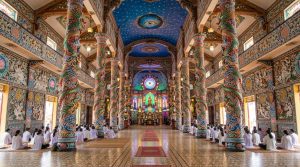
The interior is rich in symbolism. It’s worth taking a closer look at the columns decorated with dragons, the blue ceiling with celestial motifs, and the depiction of the Divine Eye located in one of the main areas of the sanctuary.
Rather than trying to quickly identify which element comes from each religion, it is more interesting to observe how they all come together to form a visual language of their own. The temple does not seek to replicate a Christian church, a Buddhist pagoda, or a Taoist shrine, but rather to express the specific identity of Caodaism.
The 12:00 p.m. ceremony
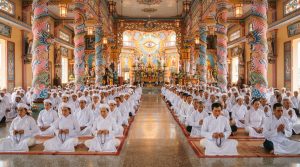
The midday prayer is the best time to visit on an excursion from Ho Chi Minh City. During the ceremony, the faithful are arranged in an orderly manner inside the temple while chants, prayers, and ritual movements take place.
It’s best to arrive early enough to tour the complex first and then take your place in the designated area for visitors. Do not block entrances or move around constantly during the prayer, and be sure to check the photography rules on-site and follow them at all times.
How to Dress and Conduct Yourself at the Holy See
Respectful attire is required for the visit. It is recommended that you keep your shoulders and knees covered and avoid particularly flashy or beach-style clothing. You must remove your shoes to enter certain areas of the temple.
There are also specific guidelines for entering the building that may distinguish between the entrances used by men and women. The simplest thing to do is to follow the signs and the instructions of the staff, especially as prayer time approaches.
From Tay Ninh to the Cu Chi Tunnels
After the ceremony, the tour continues on to Cu Chi. The distance on the map can be misleading because travel times depend on traffic and the specific route, so this second part of the day usually begins in the afternoon.
This is where the tour takes a completely different turn. You go from a religious complex full of color and symbolism to a place associated with decades of armed conflict. Visiting Cu Chi with some historical context helps you better understand what you’re seeing and prevents you from reducing the tunnels to a mere adventure.
History of the Cu Chi Tunnels
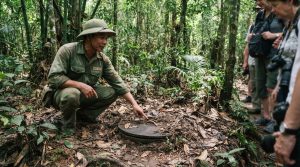
The first tunnels in the area began to be dug during the war against French colonial rule in the late 1940s. Initially, they served as shelters and small passageways used to hide people, documents, and weapons.
During the subsequent Vietnam War, especially from the early 1960s onward, the infrastructure was gradually expanded and interconnected. The result was an extensive network of tunnels, shelters, defensive positions, and logistical facilities used by guerrilla forces and local residents.
Figures regarding its length vary depending on the source and the historical period in question, but estimates generally range from more than 200 kilometers to, according to some Vietnamese sources, around 250 kilometers of tunnels. Not all of these tunnels have survived, nor are they currently accessible.
How Was the Underground Network Organized
?
The tunnels did not consist of a single continuous corridor. They formed a system with different levels, branches, and chambers, designed to facilitate movement, provide shelter, and enable resistance against military operations on the surface.
Within the network, there might have been gathering areas, kitchens, storage areas, medical stations, resting areas, and communication routes. Some exits led to distant locations or waterways, while the entrances were carefully camouflaged to make them difficult to locate.
An extremely harsh life underground
The current tourist image should not obscure the original conditions. Life in the tunnels was marked by lack of light, humidity, heat, insects, disease, and a shortage of space . Malaria, parasites, and other infections were frequent problems for those who remained in the system.
The sections that are currently open to the public have been adapted to accommodate visitors, and some sections have been widened. Walking through them today gives you an idea of how narrow they were, but it does not replicate the original conditions during the war.
What role did the tunnels play during the Vietnam War?
Cu Chi held a strategic position due to its proximity to Saigon, now Ho Chi Minh City. The tunnels made it possible to hide fighters, store supplies, maintain communications, and move around in an area subject to frequent military operations.
U.S. and South Vietnamese forces attempted to locate, destroy, and neutralize the network using various tactics and large-scale ground operations. Contrary to a fairly widespread belief, there were indeed specialized soldiers who penetrated the tunnels. Known as “tunnel rats,” they carried out a particularly dangerous task, searching for combatants, documents, weapons, and traps in extremely narrow spaces.
Operations such as Crimp and Cedar Falls demonstrated how difficult it was to completely eliminate such an extensive system. The tunnels could sustain significant damage and still provide shelter and allow movement in other sections.
The Tet Offensive and Why It Changed the Perception of the War
The Tet Offensive began in late January 1968, coinciding with the Vietnamese New Year celebrations. North Vietnamese and National Liberation Front forces simultaneously attacked numerous urban and military targets in South Vietnam.
The offensive also reached Saigon and was surprising in its scale. However, explaining the episode as a straightforward military victory for either side is misleading. U.S. and South Vietnamese forces regained the positions they had lost, and the attacking forces suffered enormous casualties, but the political and psychological impact of the offensive was considerable.
For some members of the American public, the scale of the attacks contradicted the optimistic messages about the course of the war. Tet contributed to a decline in support for the strategy pursued up to that point and intensified the debate over a negotiated settlement, although the United States did not immediately withdraw its forces as a direct result of the offensive.
The U.S. withdrawal was a subsequent process that concluded in 1973 following the Paris Agreements, while the war continued until 1975. If you’d like to better understand the celebration that gave the offensive its name, you can check out our guide to Tết, or the Vietnamese New Year.
Bến Đình or Bến Dược: Which Cu Chi Tunnels to Visit
Currently, visits to Cu Chi can be made primarily at two historical sites: Bến Đình and Bến Dược. Both allow visitors to explore the tunnel system, but they do not offer exactly the same experience, nor are they the same distance away.
Bến Đình is often included in day trips because it is easily accessible and geared toward international visitors. Bến Dược is part of a larger historic area and may be of interest to those who want to spend more time exploring the local context.
Bến Đình
Bến Đình is often a convenient option when time is limited. Organized tours frequently visit this area, and the route is designed to showcase hidden entrances, defensive structures, traps, recreated spaces, and some sections of the tunnel.
Precisely because it’s so easy to get to, it can attract larger groups at certain times of the day. If you’re looking for an efficient day trip from Ho Chi Minh City or a combination trip with Tay Ninh, this is usually a logical choice.
Ben Duoc
Ben Duoc allows visitors to focus more on the historical and memorial aspects of the Cu Chi complex. It is a bit farther away, so you’ll need to plan your schedule more carefully if you’re combining it with a visit to Tay Ninh on the same day.
The choice shouldn’t be framed solely in terms of which one is “better.” It depends on the time you have available, your point of departure, and how interested you are in delving deeper into the history. On a customized trip, we can choose the section that best fits the overall itinerary.
What Is the Current Tour of the Cu Chi Tunnels Like?
The experience combines historical explanations, reenactments, and short tours through specially prepared galleries. Before entering the tunnels, there is usually an explanation of how they were built, how their entrances were concealed, and what systems were used to ventilate certain areas.
On the grounds, you can see recreations of shelters, traps, and other defensive structures. Some tours also include demonstrations and areas featuring weapons from that era. There is a shooting range on the grounds, but using it is an optional activity separate from the historical tour.
Is it mandatory to drive through the tunnels?
You don’t have to go through all the underground sections to visit Cu Chi. Visitors who suffer from claustrophobia, have mobility issues, or simply don’t feel comfortable in very narrow spaces can stay above ground and still follow most of the tour.
If you decide to go inside, keep in mind that some passages require you to crouch to get through and can get quite hot. The tourist tunnels have been adapted, but they’re still tight spaces, so there’s no point in pushing yourself if you don’t feel comfortable.
Cu Chi and the World Heritage Nomination
The historical significance of the complex continues to evolve. In July 2026, Vietnam added the Cu Chi Tunnels to the Tentative List of properties proposed for a possible future World Heritage nomination.
This does not mean that Cu Chi is currently a UNESCO World Heritage Site. The Tentative List is a preliminary step in a much longer process. The status can be checked directly on the Cu Chi page on the UNESCO website.
Tips for taking the tour from Ho Chi Minh City
The main constraint on this excursion is the road time . Tay Ninh and Cu Chi can be combined well, but trying to add too many stops quickly turns the day into a series of journeys.
To make the most of your trip, it’s best to leave early, have breakfast before you go, and bring water and light but appropriate clothing for entering a religious site. It’s also advisable to be somewhat flexible with your return time , as traffic entering Ho Chi Minh City can be slow.
- Wear clothing that covers your shoulders and knees for the Holy See Cao Dai.
- Wear comfortable shoes that are easy to take off and put on.
- Protect your skin from the sun and carry water, especially during the hottest months.
- Don’t plan a major activity immediately after your return.
- Avoid entering the tunnels if you suffer from claustrophobia or have difficulty bending down.
- Confirm opening times, tickets and visiting conditions before you travel.
A well-organized itinerary allows you to enjoy both visits without rushing through them. If you also want to explore other rural areas in the south, it’s best to set aside separate days for places like the Mekong Delta rather than trying to cram everything into a single trip from Ho Chi Minh City.
Is it worth combining a visit to Cao Dai and Cu Chi?
The combination works because the two places offer complementary experiences. Tay Ninh provides insight into a relatively recent Vietnamese religion and showcases architecture that is hard to find elsewhere in the country; Cu Chi, on the other hand, offers a glimpse into a complex and harrowing chapter of contemporary history.
Anyone with a particular interest in either of these two places can devote an entire day to it. For a first trip with limited time, however, combining Tay Ninh and Cu Chi allows you to make the most of the trip northwest of Ho Chi Minh City.
Frequently Asked Questions About Tay Ninh and the Cu Chi Tunnels
Most questions arise when trying to coordinate travel arrangements and ceremony schedules. These answers are intended as a guide, although it’s a good idea to confirm access conditions before your trip, as they may change.
It’s also important to note that organized tours don’t all follow the same itinerary. Some visit only Cao Dai and Cu Chi, while others include Bà Đen Mountain and significantly extend the duration of the tour.
Is it possible to visit Tay Ninh and Cu Chi on the same day?
Yes, it’s a common itinerary starting from Ho Chi Minh City, as long as you set aside nearly a full day for it. The usual plan is to visit Tay Ninh first, around noon, and then continue on to Cu Chi.
What time is the Cao Dai ceremony in Tay Ninh?
Prayers are traditionally held at 12:00 a.m., 6:00 a.m., 12:00 p.m., and 6:00 p.m. For a day trip from Ho Chi Minh City, the 12:00 p.m. ceremony is usually the most convenient.
How long does the tour last?
It’s best to set aside the entire day. The exact duration depends on traffic, the specific area of Cu Chi you choose, the amount of time spent in Tay Ninh, and whether the tour includes additional stops such as Bà Đen.
Is it necessary to book a tour?
It’s not mandatory, but it makes logistics much easier. Taking the route by private transportation or on an organized tour allows you to better coordinate your arrival at the ceremony and the subsequent transfer to Cu Chi.
Are the original tunnels as big as the tourist ones?
Not exactly. Some of the sections open to the public have been renovated or expanded to make it easier for visitors to get around. The original galleries may have been even narrower and harder to navigate.
Is Cu Chi a UNESCO World Heritage Site?
Not at this time. In 2026, the tunnels were added to Vietnam’s Tentative List, a preliminary step that allows for a future nomination but does not equate to World Heritage inscription.
A day to gain a better understanding of southern Vietnam
Within just a few kilometers, Tay Ninh and Cu Chi encapsulate two very different chapters of Vietnamese identity. The Holy See illustrates the development of a religion that originated in the country and remains fully active today, while the tunnels offer a glimpse into the adaptability of a people who lived for decades in a war-torn region.
The best way to experience the tour is to take your time and put it in context. It’s not just about photographing an eye-catching temple or venturing a few meters underground: understanding what each place represents completely transforms the visit and helps build a much more comprehensive view of contemporary Vietnam.