The first question almost every traveler asks when arriving in Vietnam is the same: where and what do I eat? It makes sense. Street food here is not an add-on to the trip, it is one of its main reasons. On every street corner, a lady stirs a broth since six in the morning. In every alley, the smoke from a grill warns you that something good is happening.
The scene can be imposing at first: tiny stalls, plastic stools at ground level, letters you don’t understand. But at One More Destination we’ve been accompanying travelers through Vietnam for years and what we’ve found time and time again is that these unpretentious stalls are often where the best food is. The key is knowing what to order and where to look for it.
This guide covers the ten dishes you can’t leave without trying, with their regional variations, the context that makes them unique and some practical tips for enjoying them without scares.
Why Vietnamese street food is different
Vietnam has one of the strongest street food traditions in the world, and it’s no accident. Vietnamese cuisine balances five fundamental flavors-sweet, salty, sour, bitter and umami-with a precision that few other cuisines achieve in such an accessible format. Fresh herbs, simmered broths and techniques inherited over generations are the basis of dishes that would cost fifteen times as much in a European restaurant.
What makes it especially interesting to travel Vietnam from north to south is that the cuisine changes radically. The north, with Hanoi as the epicenter, tends toward clearer broths, purer flavors and recipes of greater austerity. The center, with Hội An and Huế, introduces more spiciness and more complex elaborations. The south, with Ho Chi Minh City, prefers sweeter flavors, more abundant herbs and heartier dishes.
Top 10 must-try street food dishes in Vietnam
1. Phở – The soup that defines a country
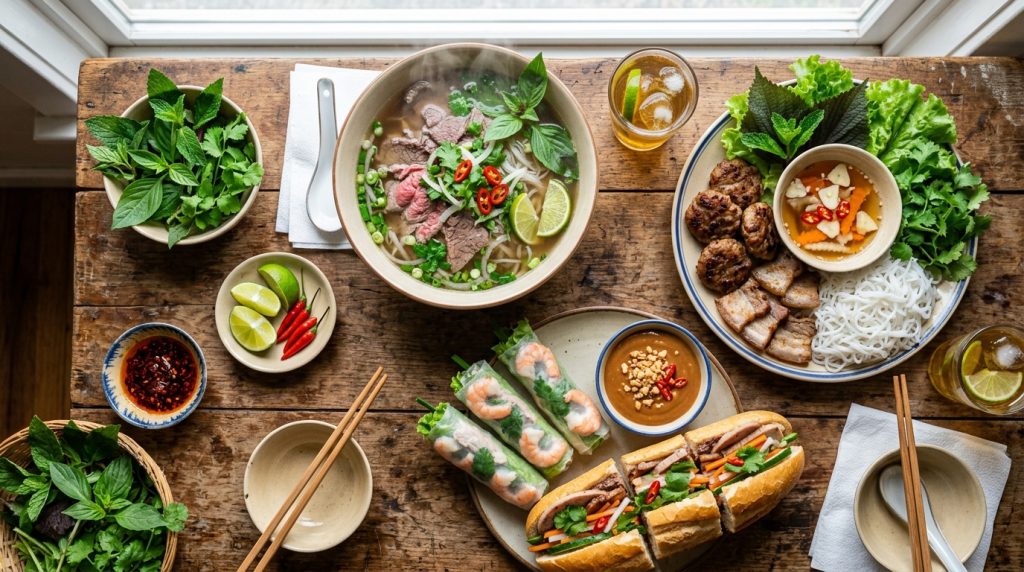
Phở is the national dish par excellence, although in Vietnam its status goes far beyond that. For the locals it has no timetable: it is eaten at breakfast, noon and midnight just as normally. A steaming bowl of bone broth cooked for hours, thin rice noodles, beef or chicken, and a tray of side dishes – soybeans, Vietnamese basil, lime, chili – that each diner combines as they like.
The northern version, Phở Bắc, has a cleaner and more austere broth, with less seasoning. The southern one, the Phở Nam, is sweeter and served with more herbs. The difference seems subtle but is enough to generate debates in Hanoi and Saigon as to which is the real thing. Guideline price: between 40,000 and 80,000 VND ( 1.5-3 €).
2. Bánh Mì – The sandwich that mixes two cultures
Few dishes illustrate the history of Vietnam better than Bánh Mì. The baguette is a legacy of the French colonial era; what goes inside is entirely Vietnamese: pâté, spiced meats, pickled vegetables in vinegar, fresh coriander, cucumber and, if you dare, a generous amount of chilli. The result is a crispy, aromatic and addictive snack that takes less than two minutes to eat while standing on the street.
Each stall has its own combination and its own sauce. In Hội An there is even a Bánh Mì with unofficial designation of origin: that of Phương, which for years was considered the best in Vietnam. In Ho Chi Minh City, the local Huỳnh Hoa is a must for travelers. Price: between 20,000 and 40,000 VND ( 0.75-1.5 €).
3. Bún Chả – The dish that captivated Obama.
In 2016, then-President Barack Obama visited Hanoi and sat down at a small restaurant in the old quarter to eat Bún Chả with chef Anthony Bourdain. The image went around the world and turned this already popular dish into an international phenomenon. The recipe hasn’t changed: burgers and grilled pork strips served in a bowl of sour-sweet broth made from fish, carrot and papaya, accompanied by thin rice noodles and a plate of fresh herbs. Nem (fried spring rolls) are the classic side dish.
The secret of the dish is in the broth: its balance of vinegar, sugar, lemon and fish sauce is what makes it unmistakable. At One More Destination we usually take our groups to try it in the old quarter of Hanoi, where you can still find places that prepare it exactly as they did decades ago. Price: 40,000-60,000 VND (1.5-2.5 €).
4. Bánh Cuốn – The breakfast rice roll.
Bánh Cuốn is one of those dishes that do not impress at first sight but, once tasted, are hard to forget. It is a very thin sheet of steamed rice flour, stuffed with minced pork with shiitake mushrooms and onion, carefully rolled and served with a fish sauce flavored with vinegar, sugar and chili.
What makes it special is the texture: soft, almost silky, with a delicate contrast of flavors that makes it one of the most elegant breakfasts in Vietnamese street food. It is a Hanoi and northern dish, so if you travel only to the south it may be more difficult to find it in its traditional version. Price: 30,000-50,000 VND per serving (1-2 €).
5. Bánh Xèo – The crunchy crêpe of the South
Bánh Xèo – whose name literally means “sizzling pancake” – is the sound the batter makes as it falls onto the hot pan. It is a large, crispy pancake made with rice flour and turmeric, stuffed with shrimp, pork and bean sprouts. How it is eaten is part of the experience: it is broken into pieces, wrapped in lettuce leaves with fresh herbs and dipped in fish sauce.
It is a dish from central and southern Vietnam, especially popular in Hội An and Ho Chi Minh City. In the north there is also a smaller version called Bánh Khọt, with shrimp and coconut. If you get a chance to see it prepared live at a market, it’s worth staying to watch: the technique with the pan and lid is quite a demonstration. Price: 40,000-70,000 VND ( 1.5-2.5 €).
6. Gỏi Cuốn – Fresh rolls that do not fry.
Gỏi Cuốn or fresh spring rolls are the lighter side of Vietnamese street food. Shrimp, pork, rice noodles, lettuce, mint and cilantro wrapped in translucent rice paper, served at room temperature and accompanied by a peanut sauce for dipping. No frying, no oil, with all the freshness of aromatic herbs.
They are commonly confused with Nem Cuốn (fried rolls), but are completely different in taste and texture. They are found all over the country, although in the south-especially in Ho Chi Minh City-they are more popular and varied. They are a perfect choice for the Vietnamese heat and for those looking for something lighter between courses. Price: 15,000-30,000 VND per piece (0.50-1 €).
7. Phở Cuốn – The roll that comes from the Phở
Phở Cuốn is literally the ingredients of Phở in roll format: sheets of rice paste rolled with sautéed beef, lettuce and cilantro, served cold with fish sauce. It is a lighter dish than soup and perfect for dinner without ending up too full.
In Hanoi, the best stalls are concentrated around Trúc Bạch Lake, north of the Old Quarter, in an area where several families have been preparing them for decades. If you’re looking for a quiet, inexpensive dinner away from the hustle and bustle of the Old Quarter, this is one of the best options. Price: 40,000-60,000 VND per serving (1.5-2.5 €).
8. Bún Cá – Spicy Fish Soup
Bún Cá is less well known among foreign travelers than Phở or Bún Chả, but it is one of those soups that locals defend with conviction. Deep-fried, spiced fish in a ginger broth with rice noodles, tomatoes, fresh dill and, in some versions, shrimp paste to intensify the flavor.
It is a more hearty and aromatic dish than other Vietnamese soups, with its own character that comes from the combination of ginger and dill, unusual in the cuisine of the region. It can be understood as a variant of Bún Chả in terms of format, although in taste they are completely different. Price: 40,000-60,000 VND ( 1.5-2.5 €).
9. Xôi – Sticky rice of a thousand combinations
Xôi is steamed glutinous rice served with a soy sauce base, to which ingredients of the diner’s choice are added: shredded chicken, grilled pork, fried egg, pate, green beans, peanuts. Each combination is different and they all work. It is the quick breakfast of the Vietnamese, the mid-morning snack and the travel companion on night trains.
In Hanoi, the best known stall historically bears the name of its owner: Xôi Yến, on Nguyễn Hữu Huân Street. A small place, always with a queue first thing in the morning, where they have been preparing the same recipe for decades. Price: 30,000-50,000 VND (1-2 €).
10. Chè – The sweet desserts that close the tour
The term Chè encompasses the whole family of sweet Vietnamese desserts: from bean soups with coconut milk to small cups layered with jelly, tapioca, fruit and cream. Hoa Quả Dầm, the fruit salad of tropical fruits – mango, watermelon, dragon fruit, pitahaya – mixed with condensed milk, coconut milk and shaved ice, also enters here.
It is the perfect end to a street food tour in any Vietnamese city, especially in the warmer months. In the south, Chè has more variety and more presence in the markets. In the north, the most popular version in summer remains the cold fruit salad, which street vendors prepare on the spot with seasonal fruit. Price: 20,000-35,000 VND ( 0.75-1.5 €).
Practical tips for eating street food in Vietnam
Eating on the street in Vietnam does not require courage, but judgment. A few principles that we have refined with our travelers over the years:
- Search for local queue. If there are Vietnamese waiting, the stall is good. If there are only tourists, check expectations.
- Specialized positions win out over generalist ones. A stand that only makes Phở has been perfecting that recipe for decades. The one with a twenty-course menu, not so much.
- Eats where there is rapid turnover. Fresh ingredients don’t wait. A busy stall ensures that nothing takes hours in the pan.
- Don’t turn down low stools. The small seats at ground level are a sign of authenticity, not discomfort. This is how you eat in Vietnam and you eat very well.
- Carry cash in VND. Most street stalls do not accept credit cards or mobile payments. The amounts are small: a full breakfast rarely exceeds 50,000 VND (less than 2 €).
If you want to go deeper into the experience, gastronomic tours by motorcycle or on foot are one of the best ways to discover corners that don’t appear in the guidebooks. In cities like Hanoi and Ho Chi Minh City there are excellent options with local guides who know each stall by name.
Where to find the best street food depending on the city
Street food in Vietnam is not concentrated in one place. Each city has its own references:
- Hanoi: The Old Quarter concentrates most of the historic stalls, especially on Hàng Gà, Hàng Mành and Đinh Liệt streets. For Bún Chả and Phở, the best locales are in alleys that don’t show up on tourist maps.
- Hội An: Famous for its Bánh Mì (Phương’s is a world reference), its Cao Lầu and its Bánh Xèo in the central market.
- Ho Chi Minh City: District 1 and District 3 concentrate the most popular stalls. Bui Vien pedestrian street is more touristy; for eating like a local, the markets in District 4 and Chinatown in District 5 are better options.
At One More Destination we design itineraries that combine the great classics with the hidden gems of each destination. If you want your Vietnam trip to include a truly thoughtful food tour – with the right stalls, the right timings and the cultural context that makes it all richer – check out our Vietnam tours or write to us directly. We’ve been on the ground for more than a decade and know exactly where to eat.